September 18th, 2026
Portugal and Spain, Easter Week 1994
Sunday, March 27, 1994
Lisbon, Hotel da Lapa
On our last evening in Portugal we are looking back on the crowded impressions of the past four days. Our uneventful Delta flight in the abbreviated Atlantic night brought us Lisbon shortly after dawn on Thursday.
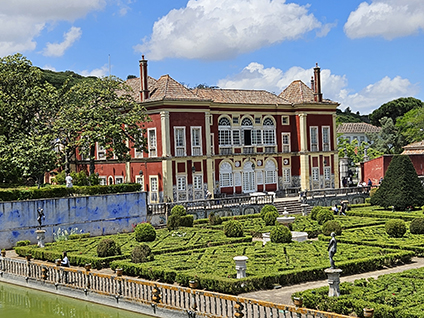
Palácio dos Marqueses de Fronteira, Lisbon.
Friday morning found us sailing over the bridge to Stubal by mistake, but fortunately we were able to turn ourselves back and arrive in northern Lisbon by 11:00 o’clock, the hour when the Palácio dos Marqueses de Fonteira is made open to visitors. The palace itself, being lived in now, is thoroughly humanized in atmosphere. The gardens, too, although very elaborate with their intricate compartments of beautifully cut box hedges, are quite domestic in scale and mood. Again, it is the tiles that charm. Here they take the form of decorative panels behind the water tank (a feature of the old Portuguese gardens where water scarcity sometimes forced the inhabitants back to Lisbon before the end of summer), along the beautiful upper terrace and on walls and benches throughout. A particularly interesting feature here is a grotto containing shell, pebble, and broken china mosaics.
Our next stop is by the Gulbenkian Collections where we first wander through the gardens, take a fast look at Portuguese contemporary art (a provincial subset of European modernism) and then spend a couple of extraordinary hours absorbing the breadth and depth of Calouste Gulbenkian’s astute connoisseurship. Here one can get a good education both in the art of collecting in many facets of art history – including antique classical coins, Islamic tiles, Japanese and Chinese ceramics, oriental carpets, French silver, French furniture, antique sculpture, and European painting from the Renaissance through the nineteenth century. A special experience because of the real “eye” and discrimination with which everything appears to have been chosen.

Alfama Old District, Lisbon.
At the museum closing time we returned to our parked car and drove to Lisbon’s historic quarter, which happens to be the site of its Roman settlement and later Medieval town – now known as the Alfama District. Ted threads his way up the narrow streets, which are set at a steep incline, past picturesque pastel-colored buildings, many with facades and side walls covered with the pretty decorative tiles that are characteristically Portuguese, with the front sides supporting narrow balconies with swags of colorful laundry festooning them. After a look at this streetscape, we drive to the wall circumscribing the Castle of Sáo Jorge where miraculously we find one parking spot. (It is incredible how these and so many other ancient European streets, which were built for carts and foot traffic, can hold so many contemporary cars.) Before getting in driving ours, we patronize the little concession in the park nearby where we gaze over red-tiled rooftops at the harbor and city below, then take a delightful walk through the ruins of the old castle, climbing steep stairs to the top of its battlemented walls where one can ponder the nature of medieval and ancient warfare while drinking in the twilight-softened views of the city and, at a more intimate distance, gardens with potted flowers, trees, and other semi-tropical plants, many of which are now in their springtime bloom. Back at the hotel, we bathe, have dinner in the dining room, and then go to bed.
Saturday is the day is the day I have planned for a drive north to Coimbra and its environs. We are now solidly a team navigating and driving the rental Volvo as we swing past the airport while heading in the direction of Porto on the A1. Even at European throughway speeds, we have a somewhat longer trip than I had imagined in preparing our itinerary, but by noon we reach Conimbriga, the ruins of the Roman city directly below its modern successor Coimbra. Two fine houses with gardens, one – the Villa of the Fountains with its beautiful mosaic floors still intact – absorb our admiring curiosity for an hour. There is a museum on the site with various artifacts such as hinges, spear heads, wine jars and other such essential hardware and clayware for the inhabitants of this ancient settlement, much of which archaeologists have unearthed – nothing of special artistic merit, but all of interest since it is from such meager and precious clues that we resurrect the lost world of colonial Rome.
After Conimbriga, we continue north past Coimbra to the Bucacao Forest where the Barefoot Carmelite monks established their community in 1648 and in their walled preserve created a kind of botanical garden, planting the tropical species collected by Portuguese navigators – Mexican cypresses (similar in appearance to cedars), tree ferns, ginkgo trees and even sequoias. Before taking off on one of the trails that traverse this paradise, we have lunch at the grand hotel that stands in all its ornate glory, cheek-by-jowl, with the monastery – in addition to the elaborately carved stone and word there are everywhere the scenic shimmer of blue and while azulejos, here arranged to form a tapestry-like wall décor.
Outside the dining room there is a parterre garden overlooked by a wisteria pergola. Ted orders turbot as a first course, followed by lamb stew, while I have cod-fish cakes and then a custard-coated, breaded tongue, which is surprisingly good.
Having tucked in this substantial meal, we are ready to explore the forest. It is fun descending into the fern valley and coming upon the Cold Fountains, the name of a kind of staircase, which tinkles delightfully as a thin ribbon of water slides from one “landing” to the next, where it collects in little moss-padded pools before trickling on down to the basin below. There are camellias in bloom and rhododendrons, making us congratulate ourselves, as lucky travelers will, on having arrived in Portugal at this most perfect time of the year.
Back in Coimbra, we drive up to the top of the hill upon which sits the fine old university. We pass students wearing black academic regalia with embroidered patches of various insignia, then encounter a wedding party. The service is over and we are therefore unable to see the inside of the chapel, but we can admire the carved door and the broad open plaza defined by proud architecture.
Just below the university, before heading back to the highway, I spot a lovely park with a truly magnificent eighteenth-century fountain. It is around six o’clock, the hour when the Iberian sunlight slants its rays in a golden wash over buildings, plazas, and, in this case, a park.
We spend a delicious hour walking around and especially enjoy the sight of three naked children splashing happily in a circular fountain pool above the tiled ornamental fountain, which had drawn our attention in the first place.
We drive back to Lisbon on the A1 in the gathering late-evening dusk, then book a reservation at a very lovely restaurant named Aviz, where we arrive a few minutes past 10:00 PM. There we both order an appetizer of snails-and-mushrooms sautéed in garlic and, for a main course, Atlantic sole for me and Turbo for Ted. Then we both share a dessert of crepes flambé. More than the meal, which was very good, was the contentment we experienced, which was overt in our mutual praise of the professionalism of the waiters and chefs as well as the two of us for our sensibility in patronizing such a well-run, old-fashioned restaurant as this.
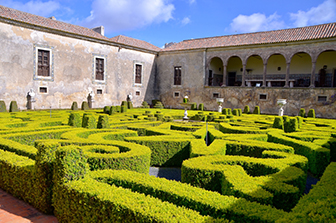
Palácio e Quinta da Bacalhoa.
Today, Sunday, began with a drive south to the peninsular part of the Estremadura, which contains the great whale-back-like hump of a limestone ridge known as the Serra de Arábida. My particular goal is to pay a visit to the Quinta de Bacalhoa, where there is a particularly fine, and very old, Portuguese garden. The country seat of Alfonso de Albuquerque, Viceroy of India, it was built in the early years of the sixteenth century. By the 1930s, it was a near ruin when it was taken in hand by Mrs. Herbert Scoville from Waterbury, Connecticut, who lovingly restored it, bringing back its Renaissance compartments of box hedges and resetting the ancient Spanish Moorish tiles. The place is still in the hands of the Scoville family and, although supposedly closed on Sundays, when Ted astutely discovers the not-very-obvious entrance gate and a caretaker who agrees to let us in.
This is a spring moment to remember. The caretaker warms to his task, proudly showing us the difference between Spanish and Portuguese tiles. The flat Portuguese ones with no relief did not begin to be manufactured until Spain and Portugal became historically disassociated in the seventeenth century. Now, I find all the tiles are beautiful when visually dematerializing and becoming clothed by a blue-green glimmer as we walk through a series of loggias facing the large water tank. Our guide has been part of the Quinta since he was a little boy when Mrs. Scoville, who was something of a local legend, became the American fairy godmother and rescued the derelict garden from further decay. Nevertheless, some of the village residents were saved from their dire poverty by employment in the great enterprise of the garden’s restoration. Even today Mrs. Scoville’s parties for the village children are remembered.
What I learn from the caretaker’s rosy account is that his employer planted with taste and skill, making, in the manner of a Mediterranean Vita Sackville-West, a long border of white-flowered and white-foliaged perennials in a running stone planter along the walkway leading from the box parterre beside the house to a beautiful pool-like water tank. Wisteria, red-bud, and other glories of spring are in bloom on this perfect morning, and we happily nod in half-comprehension as our animated Portuguese friend explains the Biblical iconography of the tile decoration of the tank-side loggias, noting that the scene of Susanna and the Elders was the one best preserved. On the opposite side of the water tank, an attractive young woman has just sat down with her little daughter to enjoy the morning sun while the child eats an orange just picked from a nearby tree. We go over and introduce ourselves and experience another chapter in the “Small-World” department. She is from Connecticut, a guest of Tom Scoville, the present owner, and coming up to get better acquainted, she says to me, “Do you know Amanda Burden? Yes, of course, I truthfully reply, and we chat amiably, l with me apologizing for abusing her Sunday morning privacy with our visit.
Our tour continues as I go on clicking my camera. The light is perfect, and the garden is at this moment a most delightful spring-blooming bower.
Having finally expressed as much admiration and gratitude, accompanied by a generous tip, to our guide, as possible, we accept his suggestion that we go with him into the kitchen where the cook shows us pictures of Mrs. Scoville and the entire family on display in the kitchen. With thanks to her and a friendly good-bye to the current house guest and her daughter, we drive off the property and turn toward the south side of the Serra de Arrábida, hoping that my mental garden-radar device will zero-in on what sounds like another very interesting and beautiful private garden from the description of it in Patrick Bowe’s Gardens of Portugal.
We never seem to be able to find the track leading to it but it hardly matters since we are in the middle of Nature’s own Mediterranean garden, climbing up the limestone mass of the Surada Arrábida with its scrub vegetation of myrole, aloe, cistus, and arbutus along with masses of wildflower, which are springing out of rocky crevices. There is even a monastery – the convento Navo tucked into the cliff face with nine stations of the Cross marching across the bluff above. Today this austere former Capuchin retreat is the property oof the Duke of Pamela, who makes it available to the “Moonies”(!).
For lunch we stop at the Estalagon da Quinta das Torres, a very pleasant Renaissance mansion, now an inn. A single waitress handles the room, and although it isn’t very crowded, the service is slow. Our meal, however, is good, and, thus fortified, we head back to Lisbon where we visit the Torre de Beelém and watch the Sunday scene gathered around it. Nearby, is the Jerónimas Monastery where there is a very good exhibit of archaeological Lisbon, the building itself an impressive architecture combining late Gothic forms with those of the Iberian renaissance.
By now, we are ready to go back to the hotel. It seems a shame that we must pack and get ready to leave tomorrow. Because we have had such beautiful weather and spent most of our time out-of-doors, we have been able to visit the Museu Nacional de Arte Antiga where we would have learned about Portuguese art from the eleventh through the nineteenth centuries. I would also have liked to visit the Tile Museum and developed a better working knowledge of the various influences and eras of azulejo design. One other regret: our abstinence from alcohol, so rarely missed, is borne with a real sense of pleasure foregone when we read the guide book’s warm recommendation of the house wine at the Buçaco hotel or are told to by all means to try “the vinho verde” from the north of Portugual.
Well, there it is: not even a glass of port, but instead no headachy mornings and lots of energy for sightseeing!
Barcelona, Wednesday, March 30
Hotel Colan
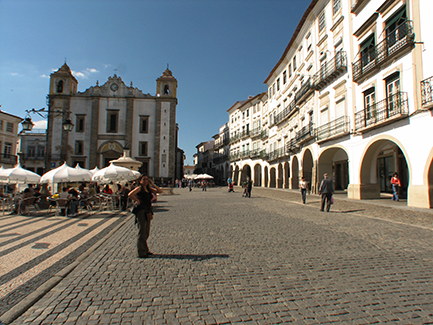
Plaza de Évora.
Our drive across Portugal and Spain’s Extremadura occupied a fascinating two days. On Monday we were on the road by 9:00 AM, reaching the historic city of Evora, once the capital of Portugal, and by noon, we were parked outside the old town walls and entering the town on foot, making our way along handsome streets with white-washed houses and, here and there, an arcade leading to the Praça do Giraldo, the principal square. Since Evora has been declared part of the World patrimony by UNESCO, the town and this square are receiving their due preservation. Like Prague’s town square, the surrounding houses here are freshly repainted or, here, whitewashed with colorful contrasting trim around the windows. What is most interesting about the square, however, is its time-honored function as an agora, (forum), a real public space where people come to meet and exchange gossip or political views, to buy a lottery ticket and do business of various kinds. Little knots of men are everywhere. Their numbers will have thinned out when we return later, so this activity is clearly a morning ritual.
We make our way to the cathedral, through more pretty streets with the “dragon’s tooth pavement, which is prominent in this part of the world where paving is still a form of handcraftsmanship. The cathedral is of a period that is between Romanesque and Gothic. Passing beneath the fine carved portal we enter the sacred gloom. Here the old stone has a nice warm nut-brown appearance and huge wrought-iron chandeliers hand- suspended from giant rosaries.
We find the remains of a second, or early third-century Roman temple beside the Church of the Lóios, which is unfortunately closed on Mondays, making us forego its beautiful tile-decorated interior. Instead, we have a very pleasant lunch in the next town of importance, Elvas, where there is an impressive buttressed Roman aqueduct and more heavy fortifications in the Vaubon manner. We climb up on these and gaze out over the countryside through the slots designed for artillery fire, after which, while admiring some irises in bloom, we walk back down to ground level and return to our car, which is parked by the aqueduct.
We reach Merida around six o’clock. Ted has had no time to do any travel research, leaving the itinerary of this trip entirely in my hands. Knowing his love for both the theater and antiquity, I have planned the Mérida stop in northern Spain as his surprise. After checking into an attractive posada, which is situated in a former convent, we walk up to the Roman theater occupying a park-like zone similar to that of the Palantine in Rome. Here we found a museum of mosaics, sculptures, tomb stele. coins, pottery, and other artifacts discovered when the site was dug, which was about twenty years ago. After prowling about the theater and admiring its beautiful two-story colonnaded scena behind a semi-circular stage, we walked through the main square.
Here is truly a fine public space for public life – a giant town living room in which everyone dressed with style and decorum whiling the early evening in small groups or as families to play. Even Sunday in Central Park doesn’t begin to approach the human intensity of it, for this is a community-scale city. Regarding Ted and me, this is an experience to treasure – watching these gregarious, genteel, urbane Portuguese citizens in their town enjoying the company of one another.
Although the posada dining room has a slightly institutional aspect to us, the food is fine. After our meal, eaten at the traditional late hour, we are ready for bed.
On Tuesday morning we “do” the Archaeological Museum and revisit the theater and amphitheater before heading east at noon. Driving through the Estremadura, I keep thinking to myself, “More Texas than Texas.” The landscape, with its limestone bones, here and there protruding; its relatively hot, dry, but not one of a disagreeable aspect. The Spanish oaks and other familiar-seeming vegetation remind me of the Texas Hill Country landscape of my childhood.
The way to go to Madrid if one has two days in which to do it would be via Toledo. That would be an even more scenic route, with Toledo itself as a special reward. We, however, must stick to the NV E 90, which is quite a good super-highway.
Even on this route we forego some delights, chiefly Trujillo, a handsome old walled city with some fine palaces built by the îndios returned to Spain after making their fortunes the New World. (Trujillo is the birthplace of several conquistadores, among them the famous Pizarro.
We swing off the highway at Talavera de la Reina where we stop at the Ermita del Prado with its sumptuous sixteenth and seventeenth century azulejo décor after having first been admitted to the bull ring next door by the kindly crone who lives on the premises as caretaker.
In the church, we observe not only the tiles, which are beautiful and historically interesting according to the contrast between Renaissance and Baroque design), Spanish piety is obvious here, and these churches are a daily refuge for the faithful and a necessary spiritual food.
At this point, spiritual food is the only food which I wish to think about. This is maybe so because all day I have had the sensation of a leaden stomach and a feeling more dire than mere indigestion. I know, however, that Ted will need me to map-read for him through the streets of Madrid to our hotel, and I am pleased to report that we are able to successfully navigate our way to our destination in a strange city.

Prado Museum, Barcelona.
Fortunately, our hotel is the Palace on the Plaza de Las Cortes opposite the Prado Museum and, with no hesitation, we made it our first stop the morning after our arrival. Excitement gripped me when I thought that at long last I would have a run through its galleries, the walls of which were hung with famous masterpieces that had thrilled me when I was a sophomore at Wellesley Collage majoring in art history and saw them as slide photographs projected in the classroom. Jonathan Browne’s excellent biography of Velazquez came back to me as I stared at one incomparable portrait after another. The “Tapestry Weavers,” with its shimmering background light and fluid brush work can only be surpassed by “Las Meninas,” a masterpiece that exploits the painting of light and ethereal space as perhaps no other painting in the history of art. By cupping your hands to eliminate your peripheral vision and thereby the plane of the surrounding museum wall, it is as if you were somehow peering over the shoulders of the king and queen, who are also somewhere in front of the picture plane, apparently gazing into that deep room and meeting the little Infanta’s eyes.
Then there is the genius of Goya, the full dimensions of which cannot be grasped without a trip to the Prado. The great black paintings, the surreal works like “The Colossus”, the “just-this-side-of-caricature” renditions of the royal family, the works conceived as interior décor – all are tinged with, or overtly express a persistent pessimism about the human condition that somehow echoes Goya’s eighteenth-century contemporary: Voltaire. None of them is more affecting that “The Third of May.” No matter how many times one has seen this in reproduction, it is an incredible experience to behold the painting in all its startling horror.
At noon it was time to leave the museum and hasten back to the hotel to collect our bags and head for the airport. There Ted and I say, with a kiss, goodbye as he leaves to catch is TWA flight to New York and I depart on the 2:00PM shuttle for Barcelona. Forty-five minutes later I have exchanged Castille for Catalulnya and entered an entirely new aspect of the Iberian experience.
For about half an hour after arriving at the Hotel Colon I sink into a mild depression, missing my favorite traveling companion and not yet awakened to this remarkable city. A walk through the tawny streets of the Barri Gotic and down the Ramblas soon dispels that brief mood, for it is evident that architecture is the soul of this city and that Barcelona is more intrinsically and naturally urbane (that is, an urbanity solidly rooted both in the earth and in human craft and technology) than almost any city in the world. Iron and brick, stone and steel, whether in a streetlight or a cornice, a paving pattern, a park bench, one sees the physical properties of nature baked, forged mechanically, molded, hand-crafted, sculpted, mortised, and so on into confident design combinations that bring pleasing surprises at every turn, not the least of these are the handsome planters, pergolas, and pieces of public art that constitute Barcelona’s new urban vocabulary. Here is clearly a city that gives fresh meaning to the definition of civic pride as it vigorously, and intelligently, reinvents itself in the wake of its semi-torpor under Franco’s long regime. It is this urban renaissance and its possible relevance to those of us who care about the design and sociology of public space in New York, which has prompted my trip here.
After a substantial Catalonian meal in the hotel dining room I go to sleep, happily anticipating my sight-seeing explorations the next day.
Barcelona Airport, Easter Sunday
Footsore from my long perambulations around the city and chagrined at my own stupidity for having fallen prey to a gipsy pickpocket while idling for a few moments yesterday evening in the Cathedral, I am nonetheless looking back with great satisfaction on the past three fascinating days.
On Thursday morning, I set out after breakfast to explore Barcelona on foot. My walk took me up the Passeig de Gracia past the recently restored modernist buildings so aptly described by Robert Hughes in his invaluable History and Traveler’s Companion, Barcelona: Gaudi’s Casa Mila, “a pale golden sea cliff” and the Casa Batllo with its Monet-like façade glittering in the morning sun. Next door is the stepped Dutch pediment of Puigi Cadofalch’s Casa Amatller, another glister of colorful ceramic tile. These buildings are the infill of Cerda’s Example, the Barcelonese grid of 1859, “the first of Modernism’s utopian city plans and, in its original form, the only humane one.” The chamfered edges designed to facilitate the slow traffic around street corners gave the opportunity for building entrances to be set on the diagonal. In the case of the organically undulating Casa Mila, also known as La Pedrera, this appears to be the mouth of a cave. Its foyer is indeed, as Hughes describes it, “a cool blue grotto.”
The light standards on the Passeig de Gracia are pure fantasies of ironwork, as ornamentally extravagant as the modernist buildings beside them. The hexagonal building blocks of an aqueous gray, designed by Gaudi, bear wavy relief. Light poles frequently end in flared seats, and these are often occupied, evidence that in Barcelona people truly inhabit public space. The Passeig de Gracia is a flaneur’s boulevard, and, even in the age of the automobile, there is the residue of that spirit. Strolling is what people do in Barcelona. It is as if the whole city, even its industrial areas. were part of the pedestrian domain, and the current urban renaissance of Barcelona is, in large part, an effort to reinforce this tendency to treat the city in its entirety as a kind of park. By working closely with infrastructure engineers, the city planners, who are responsible for the new improvements, have managed a truly remarkable feat in establishing a ¨modus vivendi” that facilitates both motor traffic and pedestrian activity.
Hailing a taxi, I go to the railway station – Estacio de Sants – to visit two of the new projects: the Parc de L’Espanya Industrial and a minimalist essay in spatial geometry: the Placa de los Paisos Catalans.
The giant black steel dragon by Andrês Nagel that guards the entrance to the park is made to house slides for kids, but most of these are fenced off, and the sculpture is blistered with graffiti. While admiring the crisp linearity, the intelligent marriage between horticulture and industrial form, and the use of public sculptures as objects for kids’ play, a park administrator such as me can’t help but notice the stiff maintenance demands of even such a practically designed public space system as this. Concrete chips discolor, ceramic tiles get nicked or broken, laminated paint surfaces become scratched, metal gets dented, and here in Barcelona, perhaps even more than in New York, which is saying a lot, there is a rash of graffiti on exposed surfaces everywhere. For now, things don’t really look too bad, but it is clear that no matter how sensibly these elegant new amenities have been constructed, there must be a solid maintenance system in place and the appropriate funding and management structure to insure that the “new Barcelona remains in good shape.
My next stop is adjacent to the Plaza de Toros, the Parc de Juan Miro, also called the Parc del Escorxador after the giant ceramic sculpture by Juan Miro, a brilliant totem topped by an eye liner sporting what appears to be horns. Around this landmark kids go whizzing by on their on-line roller skates. Clearly, “blades,” as they are called, are big in Barcelona; the smooth pavement of the generous plazas set within the new parks or along the malls of the re-created boulevards have been enthusiastically appropriated by kids for this purpose. Counter-balancing the wide paved areas and the clay-composition surfaces for games, are green and shady zones, their sinuous paths and waterbodies forming a pleasing contrast with the un-vegetated, more geometrically designed areas.
Passing the Hispanic-Moorish bull ring, I arrive at the Plaça d’Espanya and begin my ascent of the Avenue Reina Maria Cristina, which leads to the Palace Nacional, set high upon Montjuic as the centerpiece of the 1929 World’s Fair. I wend myself somewhat haphazardly through the Montjuic landscape and fortunately find myself entering a museum dedicated to the famous and much-revered modern Spanish painter Juan Miro. Built as a gift by Miro to his native city, its white-washed and light-washed walls are a perfect foil for this great artist’s works. Standing inside, I felt the same little rush of happiness I had felt about the remaking of the world through the same kind of intelligent purist architecture back in the 1960s.
At the door to the museum I hailed a taxi and asked to be taken back to the old section of town where the Picasso Museum is located. A long tourist line to which was added a busload of American teenagers on tour makes me reconsider, and I go instead to the Textile Museum, which is a short distance away down the same street. Like the Picasso Museum, this one inhabits one of the old baronial palaces of this quarter and is an instructive place to see Spanish period dress and learn about the various methods of textile fabrication through the centuries.
I am now not far from one of the city’s recently refurbished public spaces. I walk up this grand pedestrian promenade to Josep Vilascca’s Arc de Triumph which has been brightened up by recent restoration and serves as a gathering place for the ubiquitous roller-bladers. After more fortuitous outdoor rambling and digesting the local scene, I am weary, having shouldered my camera bag all day, taken several rolls of film and walked several miles. Happy, I wander back to the hotel and have a cup of tea. For dinner I go to a restaurant near the back of the Cathedral where I am served in the overly abundant Cataluayan fashion seafood paella.
The next day – Good Friday – when all the museums are closed, as well as most of the shops, I set out with Pedro, the driver I have hired to take me on a sight-seeing excursion to the more outlying parts of the city. Commendably, the new parks are placed all about the city in some of the toughest and poorest neighborhoods as well as the more prosperous ones. Our first stop is that much-debated icon, the Temple de la Sagrada Familila. Hughes is right: the attempted completion is misguided, a kind of self-theming that appears to be the art of Catholic Europe in its death throes, a creation that would find itself more at home in Orlando, Florida, than in refined Barcelona, Spain. The additions cast even the genius of Gaudi’s original inspiration in a questionable light.

Looking down on the main square of Parc Güell, Barcelona.
But that genius shines brightly forth in the Parc Guell, which has been beautifully restored in all the splendor of a stage set out of Wagner via the Pyrenees and the Mediterranean. Here, of course, there are no straight geometries: everything is like a visit to Albrecht’s underworld, but one made joyful with the most inventive and brilliantly colorful tile-work imaginable. The park is packed, this being a holiday, as well as a sign of the considerable pleasure that Barcelonians are taking in their newly restored open spaces.
There are plenty of enthusiastic Japanese visitors, too, since they are wild for Gaudi-san. The tour group breakfasting in my hotel are being shepherded through the park by their professorial guide. The curving walkways wind this way across the terraced hillside, up and up, offering increasingly panoramic views of Barcelona and the sea. The spikey Mediterranean plants interestingly reinforce the bizarre architecture. I enjoy visiting the house where Gaudi lived, celibate and pious, a monk-architect among the beautiful furniture of his own design.
Back in the car, we continue our ascent into the foothills of the Pyrenees while passing some imposing old villas, now used as corporate offices, to the funicular station where I make a café rest stop. Then we visit the area surrounding the Velodrome where bike races are held. Here, there is a giant insect-like piece of sculpture, by whom I can’t find out, and, as is the case with the other pieces like it, which are scattered across the city, it is there to be climbed and sat upon (as well as to be scrawled over with graffiti).
Our last stop is the Parc del Clot. When I return to the hotel, there is a surprise for me: a message saying that Josep Acebillo has called. Somehow, this highly regarded head architect of the team that is behind the current rebuilding of Barcelona, has been tipped off that I, as a designed landscape aficionado with a special interest in the role that parks have in urban planning, am in town and would like to meet with him. With this fortunate prospect in mind, I wander off to see the Good Friday procession cross the Ramblas as “Penitents,” wearing masks with pointy hoods and robes designed according to paintings of the Inquisition walk in bare feet while dragging chains. Stunned by this scene, I realize that this is Good Friday and part of Spanish Easter.
Having tracked me down, Acebillo has left a message that he will be available to meet with me on Saturday morning. This is really a piece of good luck since this young architect is the head of the urban design team that is delineating the new face of Barcelona. Now, to my pleased astonishment, he has kindly given up a week-end day that is part of his holiday visit with his various family members in nearby Sitges, a pleasant seaside town that serves as a nearby resort where Barcelonians can relax and enjoy gardens of their own.
By ten o’clock, Josep and I are on our way to visit some of the improvements I have missed in my previous two days prowling about the barrios of Barcelona. The most exciting observation I brought away, and one in which Acebillo and his colleagues have demonstrated a n urban-planning brilliancy unequalled anywhere else. I have seen with my own eyes the humanistic design treatment of highway exchanges.
By working from the infrastructure up, and effecting its design, rather than merely coming in the wake of the engineers to do a bit of roadside, or parking lot, landscaping , the have arrived at a much less anxious co-existence between human beings and the automobile than one could imagine possible. Instead of the typical spaghetti inter-lacings and boring clover-leafs, they have created big spiraling circles that are generous enough in scale to contain interesting and highly useable park spaces within them.
The high-tech detailing is not complicated, but extremely elegant. And, yes, there are people using these areas in various pleasurably ways. Intelligently buffered from the surrounding roadway so that noise and hazard are not a problem and in fact serve to convert the dead space of these interchanges into a positive amenity. A trip to Barcelona would be infinitely instructive for our roadway engineers. The trick, of course, lies in the collaborative nature of the design process here where a team approach is undertaken from start to finish.
By two o’clock, it is time for Josep to rejoin his family in Sitges where his sister-in-law and her husband are celebrating their twenty-fifth anniversary.
“Do you like rice?” he asked me. How very kind! I am invited, too! Off we go south toward Tarragona, and soon I have the pleasure of meeting Josep’s family and seeing the home of Hortensia and Jorge, a lovely white-washed villa with heavy exposed wooden beams and tile floors – a real Spanish house! The paella is delicious, and I even take a sip of the excellent Spanish wine.
The Acebillo’s daughter is there and Jorge and Hortensia’s son and daughter as well as their grandmother and grandfather. There is a wonderful anniversary cake for desert and, as a joke in my honor, the grandfather sings “Happy Birthday” in English as Hortensia flows out the candle on top.
Around five o’clock we make our warm good-byes and head back to Barcelona, stopping to admire the historic heart of Sitches and its beach promenade along the way. By six o’clock I am back in my hotel room. Expecting to see the sardana, the Catalunyan dance that is performed every Saturday evening and Sunday afternoon in the Cathedral Square.
I go downstairs, camera bag in hand, at seven, the hour it usually begins. I have coffee at the bar, but by seven – the hour the music usually begins – it is apparent that, this being Holy Week, there will be no dancing. I wander – fatally – into the Cathedral and happily meditate upon the overall pleasures of my trip. As I sit in contentment, my privacy is invaded by a sallow-faced woman who tries to engage me in conversation, asking me in Spanish, when the Mass is going to begin and, oddly, handing me a candle. In my stupid niceness, I politely hold the candle, too well-mannered to show my annoyance while her accomplice is fishing into the pouch of my camera bag (so, in hindsight, I now surmise) in order to fish out my wallet. For the first time in my life, I have over-provisioned myself with cash for the trip and left none of it in the hotel safe and thus the loss when I discover it later when I am en route by taxi to the Villa Olimpica, which Josep has recommended my visiting, is considerable. But now, after I was able to conduct a conversation with the concierge at my hotel, I have been able to negotiate my way through my unpleasant crisis, getting my Visa and American Express credit card numbers voided for now and directing the bell hop to accompany me to the police station in order to report my theft.
Business is brisk there, and I have to wait my turn to have an official hand me the appropriate form that duly records my loss, which turns out to be only one of many similar incidents of the holiday weekend.
Well, it is one thing to watch soulful penitents parading in chains and devout women on their knees before altars in a wax-scented cathedral and another to experience personally the fact that holidays are working days for beggars and thieves! We middle-class folk who float rather comfortably through life on our little clouds of money always feel so violated and outraged when what was ours gets taken away, but we are the natural prey of the have-nots, and their sharp-eyed, wily dexterity in a clever low-life existence is admirable in its own way. I feel sure I won’t feel so philosophical when I am standing in line to get my new driver’s license, but for now I can say that the past ten days have given me much food for thought, the always enjoyable companionship of my dear Ted, and all in all a good deal of pleasure never to be forgotten.
Share









