August 11th, 2026
National Outdoor Leadership School (NOLS)
Because of my desire for mutual experiential bonding with my boy, l enrolled myself in 1990 in the NOLS camping experience open to adults. Thus, I would be guided through the same Wind River area of Wyoming that gave him new skills and powers of self. Now it was me venturing forth into an unknown dimension of personal experience: life out-of-doors in a mountain range for two weeks with a group of perfect strangers. Like little Alice in Wonderland tumbling down the rabbit hole, I kept feeling “curiouser” and “curiouser,” wondering why at age fifty-four, I elected to undertake this adventure.
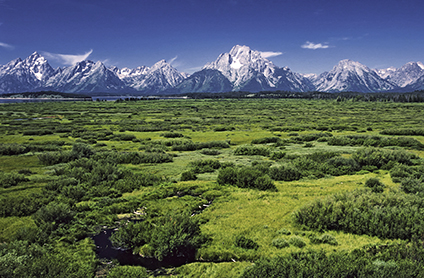
View over the Willow Flats area to the Teton Range.
All qualms aside, the drive following the route I had to take from western Wyoming east to the town of Lander was fascinating from a geographic (and geologic) point of view. First, for forty miles, more or less, there were the majestic Tetons ahead, beside, and then behind me – towering beacons, bright in the morning sun. Within the National Park I saw a herd of buffalo grazing in a broad meadow, then turning east at Moran Junction (named I suppose for the great American artist of Western scenery, Thomas Moran), I headed toward the Togwotee Pass, which is the Continental Divide. Twenty miles or so beyond the pass I turned off the highway and took the well-graded dirt road that leads to Brooks Lake, my chosen picnic spot. A light rain was falling, so after photographing the shelving mountains of sedimentary stone – so different in appearance from the deeply folded ancient gneiss of the Tetons – rising almost like high-rise architecture around the lake, I ate my crackers-and-cheese lunch in the car. Continuing east I was amazed at the novelty of the scenery scrolling by – great red rocks giving way to yellowish bluffs with a much drier sagebrush landscape here in the rain shadow. This is the land of the trailer home, and what passes for civilization in these parts is thin and meager indeed. In compensation, there is a vast immensity of earth and sky as far as the eye can see.
Looking out my rented car window, I wondered what life would be like, living close to the land as a rancher woman in a big country.
After the lush landscapes of forested canyons and wildflower meadows I have walked through before in the American West, the aridity of this part of Wyoming, redeemed here and there by fields of rye made verdant by irrigation, gives me a few tremors of dismay. I remind myself, however, of David’s praise of the beauty of the Wind River Range and press on. By two o’clock I have arrived at the Riverton airport, where I turn in my rented car and meet the bus driver and some of my fellow NOLS hikers who are just arriving on the airplane. Now I have met my group and our two leaders –Tom and Kathy, who are both heroically wholesome outdoors people. Martha, a psychotherapist from Atlanta, Jeff, a chemist from Urbana, and me, a park restorer and New York City adoptee. Soon we find ourselves at the Hitching Rack, the “best” restaurant in town. It was a delicious meal, made more so by the knowledge that it is a “last supper” of sorts. Then, like campers, we sat in a circle and talked about our trip as we studied the U.S.G.S. maps Tom had spread before us (each one of us has a set covering the area of the southern Wind River Range where we will be hiking). After this tutorial it is bedtime and a sentimental experience for me: crawling into a top bunk (I haven’t done that since my young years at Camp Arrowhead. I now find myself in a dorm-style room with three other women (my last night in a dorm was thirty-three years ago at Wellesley). It should be a hardship for one accustomed to luxury-style travel, which in my case is due to my dear husband Ted, but I feel quite happy – almost as if I had taken a lease on a second life and traveled back in time to the years of my youth.
Wednesday, August 8, 9:30, Three Elk Lake, Wyoming
To say that we are “roughing it” is no exaggeration, but with just two days of wilderness instruction I realize both what a tenderfoot I am and, at the same time, how much I have learned to do without, happily.
Sunday was spent in packing, or rather, repacking and leaving behind many of the items such as shampoo and deodorant, which I had carefully siphoned into the smallest, lightest containers possible. Even soap and toilet paper were forbidden since NOLS hikers must lighten their packs and become children of nature as much as possible.
It is really fun learning the ways of camp life with Tom, a physically energetic sort of man who puts his whole heart into teaching amateur wilderness hikers. He is also humorous, intelligent, and kind. After a big packing scene at the NOLS supply depot we climbed into a bus and Tom gave a brief geology lesson as we looked at the sedimentary strata gently tilting upwards toward the Wind River Mountains, behind which great cumulus clouds were piled like whipped cream in the afternoon sky. About two hours later we were at the NOLS Ranch, which functions primarily as a place for the pack horses that are used to resupply we hikers taking NOLS courses in the field. (Pack goats are used on some courses, the “B” section of ours, for instance, and they are run by a latter-day mountain man, Ed M for short, a popular figure in these parts). We learned to pitch our files in a clearing in the smoky blue sagebrush and, after a bag-lunch cum supper meal, crawl into our sleeping bags. Even without the thermo-rest mattress pad, another item vetoed because of bulk, I fall peacefully to sleep after watching Tom’s “how-to” performance as he put himself to bed outside with a baseball cap visor holding his Deet-smeared mosquito head net away from his face.
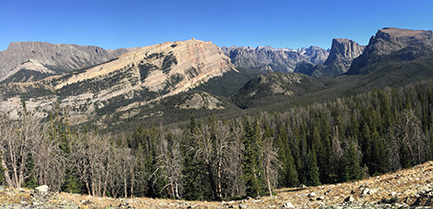
Wind River Range in the Bridger-Teton National Forest.
On Monday morning after breakfast we were driven with our gear to Scab Creek trail head, which is near the ranch. There we hoisted out packs on our backs and began our ascent up what Tom affectionately calls Struggle Hill. Yes, I found it a struggle indeed, even though I had lightened my pack and eliminated my camera, which I had planned to bring along, I was carrying between forty and fifty pounds of personal belongings, group gear, and food on my back. “Don’t wimp out, Ma!” David had admonished before I left, and I kept these words in mind as I put one foot in front of the other, up, up, up, like the “Little Engine that Could,” one of my favorite children’s stories. At last, the trail leveled off and then we started to hike off-trail to the spot where we were to rendezvous with Rob, our horse-packer, by a small lake.
After we had reconnoitered we set camp. My assigned tent-mates, Norman and Ted, and I chose our tent site and a nearby kitchen site on a granite ledge. After getting water from the lake, we teamed up with another tent group and cooked dinner: spaghetti with tomato sauce and curried couscous. Oh, but I left out one event that occurred in between setting up camp and dinner: Tom’s sanitary hike to a spot far removed from water where the four women and eight men in this course were instructed on the correct (NOLS) way to defecate in the wilderness. Note: The single theme that runs through every activity of a NOLS program is respect for the environment, and nowhere is this more true than in the matter of human waste disposal. One digs a “cat-hole” with a trowel after carefully removing a layer of duff (in no instance is plant material disturbed). Organic soil is then applied to one side, and the mineral layer below is left undisturbed since it does not contain the organism to break down human feces. Now Tom squats over the hole to show the appropriate posture assumed by the two-thirds of the world that is unacquainted with porcelain bathroom fixtures, after which he produces a smooth, bark-less stick he had found enroute, which he presents as the wilderness substitute for toilet paper. Another stick is used to mix organic soil into the imaginary feces, and afterwards the duff is sprinkled back on top, and the site is left in seemingly pristine condition.
Tired from the arduous hike and the adventures of the day, I lie in bed beside my two snoring roommates and fall asleep. In the morning – yesterday – we rise a little after six and get the stove going for coffee. Since we are only one day into our trip and have as a luxury, fresh eggs for breakfast. I scramble up a dozen or so of these and serve them on flour tortillas, another item that won’t travel or store well. Then we clean up, break camp, separate into two groups of six plus one instructor, and begin another journey off trail. My pack is really quite heavy and Kathy kindly suggests removing the fuel bottle and a two-pound chunk of cheese during a rest stop. Thus lightened, I find the going a bit easier. Our route is not a long one, only about three miles, but there is a good deal of forest-fall to scramble over and several pauses as we stop to practice map-reading skills and reorient ourselves. By around two o’clock, however, we have spied the pack horses, which are grazing near the lake. Ted, Norm, and I pick a tent site not far away from them, so it is pleasant just now as I write to hear their night bells jangling, a comfortable domestic sound of the olden days.
After making camp, we gather in a wildflower meadow beside the lake to see Kathy and Tom demonstrate fishing knots, a preliminary lesson to get us ready for fly catching. Kathy then gives us a mini lecture on feminine hygiene and personal cleanliness. With this encouragement, I set off for the woods with my surreptitious soap bar and take a nice sponge bath, rinsing first with water from my water bottle before wading a few feed into the lake to splash my body clean. I even manage to wash some clothes, while Ted, whose slender social skills have led him to brag about how well a man can cook dinner – and himself in particular – is dumping canned chicken, chunks of potato, onions, and carrot into a pot of boiling water. It actually tastes quite good with the buttered bagels he has toasted in the frying pan A few splatters of rain are not enough to interrupt dinner preparations, clean-up, and getting ready for bed.
Today we devoted the morning to fishing instruction. I need a lot more practice casting to be any good, but I hope to improve with time. Made tortillas with melted cheese for lunch, then read Edith Hamilton’s Mythology during a gentle shower until Kathy came to call us to another assembly where we studied knots and planned the route we will take tomorrow to rendezvous with Tober and the horses.
August 9, 7:00 AM, Three Elk Lake
We have just broken camp and I am waiting for the water to boil. Today we will hike another three miles along the routes each of us has chosen to reach the small lake and meadow that is to be our destination tonight. I hope that I will sleep better there inasmuch as I awoke this morning having dreamed that I had been given by some museum official a precious drawing by a famous artist, and the drawing was in the process of conservation. In my dream I tried to add my own special touch – two lines to the female body that I thought the artist might have intended – on officials looking over my shoulder would be aghast. Now, as I think of the four small squares of toilet paper carefully, sinfully, and most artfully buried in the ground three hundred feet from where I sit by our camp stove, I wonder if the NOLS attitude of respecting the wilderness as a work of art wasn’t the subconscious text of my dream. We are constantly being reminded of various techniques of “low impact” camping: if a fire ring is built, it is deconstructed; if sa log is moved to set up a tent fly, it is repositioned when camp is broken; all garbage is carried out, including soiled tampons. An ethic of environmental respect is being taught, and it is truly admirable: doing with less, recycling garbage, conserving energy. These are daily lessons that NOLS students carry back to their lives in the “real” world.
Saturday, August 11, South Fork of Boulder Creek, Raid Lake Quad, Wyoming
Our route today took us mainly in an easterly direction along Boulder Creek, aptly named since it runs through a large boulder field, which had to be traversed alongside a stream that must be forded in order to stay dry. This is beautiful country – dry and with soft air that is fragrant, which reminds me of the landscape and atmosphere of the summers of my Texas childhood. Not since those happy, seemingly timeless days have I felt so thoroughly at home in nature Today I remember Miller Creek as, at our noon lunch break, I bathed with Janet in a shallow pool of the South Fork of Boulder Creek. The sun and mountain air dried us quickly, even my hair which I gave a shampoo-less washing.
We arrived at this camp by 3:30, I feeling bone-weary from so much up-and-down climbing. Norman and I picked out a site for our tents. Then I went to the stream for water with thoughts of dinner in my head. The NOLS provisions are actually quite tasty with good herbs and spices and a variety of baking materials – flour, yeast, cornmeal, baking powder – as well as several kinds of grain – bulghur, couscous, rice—and three types of pasta. A small recipe book gives interesting meal suggestions and recipes plus such instructions for outdoor cooking as how to bake a cake in the all-purpose frying pan (place on camp stove and build a small twiggy fire on top of lid). Who should appear but Ted, demanding that he cook dinner tonight. I tried to reason him into cooking one of the meals from the recipe book and was chagrined that I proved incapable of overmastering his heavy-handed bullying as he insisted on making his own creation: a kind of stew of potatoes, rice, pinto beans, green chilies, tomato paste, onions, and garlic, topped with cheese. Actually, it was not unappetizing, only tiresome to have to cooperate with this overbearing, immature young man.
After our meal we hiked across the marshy meadow to a group of rock outcrops where Tom told us that we would be moving on tomorrow, this after reading a short article on the life cycle of the mosquito, our common enemy, which is particularly prevalent here. With maps out, we then planned our route, a long hike (5 miles), but one which will be considerably easier than today’s since we will be following pack trails most of the way.
Sunday, August 12, Middle Fork of Boulder Creek, Halls Mountain, Quad, Wyoming
Night is falling, and a distant roll of thunder sounds from the direction of the place Tom calls the Hall of the Mountain Gods. If it is cloudy tonight, we probably will not be able to see the meteor shower that is supposed to fall. But already it has been a day of pleasant surprises, and, while I am grateful to Tom, Kathy, and my NOLS companions for the role they played in helping me achieve a new sense of my own potentialities, my deepest appreciation is reserved for my son David. His were the words that echoed in the back of my mind as we started off to rappel down the side of a shear rock face half a mile east of our camp. “Don’t wimp out, Ma!” he had warned. “Go for it, don’t just decide to stay back and do something else. “Challenge yourself.” So, David, it was a special pleasure to realize that, even though I saw little circles signaling trout biting in the lake and thought about opting out on the rock-climbing lessons and choosing the more tranquil pleasure of fly-catching, you would have approved of my decision to take advantage of this opportunity to do something more personally courageous.
Tom had preceded our 8:30 departure, stepping over the springy mats of bog willow spangled with wild asters, on up to higher meadows studded with boulders (in one we found the camp of a horse-packer), through spruce trees and boulder fields, past trickling brooks with clumps of bluebells growing out of rocky side crevices, and on up and up – now winded and rest-stopping to catch enough breath to climb up the high plateau where Tom had already set up belay ropes. To put things into perspective, he had said several times that this was purely an optional activity and anyone who simply wanted to enjoy the day was free to do so. There was no pressure (other than personal) on any of us to do anything we didn’t want to do.
Several of us did not wish to walk off a cliff backwards, even though we would be securely harnessed to a rope tied to another rope, with our companions belaying us as we stepped sideways downslope. Such ingenuity should provide for us a double measure of security. However, Janet, who runs an educational program for hospitalized kids in Austin, Texas, let her qualms mingle with mine as we chugged up the last few feet to our “moment of truth.” Norman, my tent-mate from Miami, was more taciturn, but equally nervous.
First, Kathy demonstrated the proper way of snapping carabiners onto the harnesses of tubular-woven tape, which we tied around ourselves by using the double water knot we had been taught. To this body-sling a rope is attached with a double figure-eight knot. Then, applying a miniature boulder to simulate descending, she showed us the proper posture and way to guide the rope as one simply walks down a perpendicular rockface. Interesting. Though skeptical, I stepped into the leg holes I had knotted and harnessed myself up. In the meantime, Steve Anderson, a soft-spoken car dealer from Memphis was the first to rope up for real and, with his belay men in place, he called out “Ready for repelling!”
I got the carabiner placement figured out and walked off Kathy’s mini-demo-cliff a few times. The rope slipped through the friction point created by the clasped carabiners steadily and smoothly. “Why not?” I thought, and after Bill, who works for the Army Corps of Engineers in Baltimore, had rappelled off the “real thing, I volunteered. After first serving as belay for Victor, a physicist from Glen Echo, Maryland, and with Tom’s encouragement, I slid my heels over the edge of the cliff and, with the rope rolling out, began walking down the lichen-spotted rock.
“How lovely,” I thought as I spied little clumps of wildflowers tenaciously clinging to the tiny scraps of soil in the cliffs of rock I was passing over. No longer afraid, I was simply exhilarated. Three-quarters of the way down, I spied three carabiners that must have dropped out of Victor’s hard-hat as it was being pulled back up (there is not enough equipment to go around, so we have devised a hand pulley system to keep it rotating.) I stopped on the ledge, where the carabiners were resting, stooped and picked them up, then continued my descent which, all told, totaled between 75 and 100 feet.
When I yelled, “Belay off!” I felt like a million dollars. Then I chugged happily back up the grassy part of the hillside that provided non-technical ascent. There were friendly cheers and especially affectionate greetings from the other women in the group. Janet, in fact, was donning a hard hat and getting ready to rappel. By around 1:30, all twelve of us had screwed up our courage, taking inspiration from Tom, Kathy, and one another, and felt the rewards of challenge accepted and fear overcome.
We were ready for more. Several of us wanted to rappel again, and Tom had already set up climbing ropes, so it was possible to both rappel down the cliff and then climb back up. Eating my oatmeal wafer with peanut butter, I though how nice it would be to hike the rest of the way up the ridge, our cliff being not far from the top. Paul Dry, a stock trader from Philadelphia, well-read and interested in my work in Central Park, offered to come with me, as did Janet.
I kept thinking of Ted, not just missing him as I had been during this whole trip, but excited from the thrill of high places that he, too, had been experiencing on Mount Elbrus in Russia. How he would have loved the view that kept unfolding panoramically as we went higher and higher. Stepping over spruce mats and scrambling on top of boulders, we mounted a high knob – not the actual top of the ridge, but a summit of sorts. Paul took out his map, and, lo-and-behold, we saw the exact same topography spread out beneath us: lakes, streams, mountains, knolls. Beyond our side of the mountain, we could see on the other side of the ridge more glacial lakes and other mountains. It was a sight in which to rejoice, and I did.
After taking the obligatory summiting-the-mountain photographs, we hiked back downhill to join the waiting group of happy belayers, climbers, and rappelers, who were now our NOLS friends. Bill, his knees skinned, his face smiling, was scrambling up over the edge of the cliff and thanking his belayer. With a sense of fun replacing my morning fears, I decided to rappel again and maybe even try to climb back up. I was all harnessed up and set to go when rolls of thunder and menacing clouds started to move toward us, and a sparkling spittle of rain could be felt. “O.K., let’s wrap it up.”
It’s time to boogie on out of here,” said Tom. Paul, who was about to belay me, and I were chagrined. We had missed our turn. But the disappointment was minor compared to all the other rewards of the day, not least of which was seeing Janet’s momentous increase in self-confidence, Martha and Norm overcoming their deep anxieties, all of us feeling good about ourselves and each other.
I led off downhill, stopping with Victor to refill water bottles in a mountain freshet, then again at another steam where I spied a perfect little pool to rinse out my now-smelly, oily hair (NOLS ethic of low-impact camping forbids soaps of any kind, including shampoo, on lakes and streams.) It felt wonderful, massaging my scalp as the cold water poured through my hair.
When I reached the edge of the lake, I noticed that fish were biting and decided to come back and try to catch a trout for dinner. Back at camp I collected fishing gear, but by the time I returned to the lake, it had become windy and rain-threatening again, so after a cast or two, I filled up our water jug, retrieved my hat, which had blown away in the water, and trudged back uphill once more. Ted has concocted a soup of potatoes, canned green peppers, noodles, dried onion, dried peas, carrots, and cheese, which was remarkably good. It was hot and nourishing, and so we went to bed well-fed and content.
Monday morning, August 13, Middle Fork of Boulder Creek
Camp was broken and we were waiting to begin our hike toward Halls Mountain. Every scrap of debris had been collected, stake holes refilled with dirt, and the place left once again for the deer and the antelope, whose excrement and tracks we saw on the ground along with the hooves and dung of horses. (On the last two days Rob and the pack horses would be gone and we would carry our own food.)
As we came down from the high ridge yesterday Paul began recalling Wallace Stegner’s fine novel Angle of Repose, which I suppose was because of the many boulders poised on the steep slope. The book, of course, is not about physics or geology, but about a frontier marriage and the mutual accommodations to character and hardship it entailed. How strange, in a way, that we in the late 20th century, with our sturdy Patagonia camping clothes, sunscreen and mosquito repellent, are making a recreational adventure of what for our forebears was the very texture of daily life: coping with the conditions of wilderness travel and habitation. I think of them often, those ancestors of mine – Dysarts, Ewings, Appersons, Pettys, Brownings – and the challenges and limitations of their lives. I remember particularly reading about my great-grandfather James Petty climbing to the top of an elm tree and gazing out at a brown sea of buffalo on the rich plains of East Texas. I think of the Conestoga wagons mired in mud, the treacherous river crossings that sometimes cost lives and always cost time. Now that my clothes are as soiled as those of a homeless person in Central Park, my hands brown and coarsened with chipped and dirty fingernails, my hair dull and lifeless and slightly greasy, the aroma of sweat permeating my clothes and person, I realize that this is how the ancestors were all of the time. Since then it has been a steady progress toward well-stocked drug marts with universally available deodorants, lotions, hand and face creams. Toothpaste, mouthwash, shampoo, hair conditioner, and a thousand other “necessities” produced by an affluent capitalist economy. The truth is that these things – and by “these things” I include hot showers, three-star restaurants, newspapers, theater – are not so inevitably a fair exchange for sunsets, wide horizons, pure air, murmuring brooks, and wildflowers. The economy of living that is the fundamental NOLS lesson is in some sense a return to the “good old days” of living simply and in harmony with the land. There is, of course, more than a degree of romantic nonsense in what I have just written. The truth is that we need to protect and enjoy both civilization and nature, urbanity and wilderness.
Tuesday, August 14, Camp West of Halls Mountain
On Sunday my thoughts were continually turned toward my son Dave (“Go for it, Ma!”). But today it is my dear husband Ted who is uppermost in my mind, not that perpetual threads of homesickness for him and all my loved ones hasn’t run through the fabric of each challenging day of this remarkable trip. Ted companioned my thoughts as I ascended Medina Mountain and as I scrambled over boulders to ever-loftier views of other mountains, lakes, valleys, steams, meadows, and forests. During all of these hiking days I kept wondering about the contemporaneous experience he was having during his climb up Mount Elbrus in Russia and of his well-being and happiness in his recent adventures.
Coming back to the present, my current day began at 4:30 this morning as I crawled out of my sleeping bag, brushed my teeth, and cooked oatmeal for a pre-dawn breakfast with my tent-mates. By six o’clock we were ready to start hiking with the rising sun. The grass was rimmed with the night’s frost as our sturdy boots passed over the meadow where the horses are being pastured. Then we followed a creek that threaded itself through a couple of lakes (creeks and lakes in this highly glaciated countryside are strung together like necklaces) to the base of Medina Mountain. I should say that our little mountaineering party was composed of my new tent-mates, Steve Anderson and Janet, as well as Norman, Martha, and Kathy (our leader, but acting the role of follower in NOLS fashion) as we practiced our new map-reading / route-finding skills – not a hard task in this case. The other group, led by Tom, had got an even earlier start for their longer and more difficult expedition to the summit of Halls Mountain. Although it was hard work climbing these Wyoming mountains, which look so impressive but are not in reality especially high, most being in the 10,000-foot range. What was most remarkable to me, besides the thrilling views, were the tenacious moss campion, dwarf sunflowers, skunkweed (a lousy name for a plant with beautiful blue flowers) and several others that, without an official wildflower guidebook, I am powerless to name – flowers that one only sees for the most part in the rocky crevices high above timberline.
We reached the summit by ten o’clock and could be seen through binoculars by the Halls Mountain group, who had achieved the top of their peak at about the same time. It was exhilarating and peaceful to lie in the sun resting after our exertions. We found the register we had been told was there by fishing in a mound of rocks. It was a band-aid box with a tiny notebook and stubby pencil inside. We all duly signed this log, then observed a pika whose habitat we had invaded. We also noticed the mosaic of burned forest below and studied with topo maps spread out and revealing the route we had traveled from our last camp and the route we will travel down Boulder Creek to the trailhead where this expedition ends.
Then it was time to descend. I feel more confident and sure-footed hopping from boulder to boulder now, depending on the good traction of my well-constructed book soles. Soon we were back in the valley following lakes and streams again. As we got to the second lake, I asked Janet and Martha to join me for a bath. We all three splashed our naked bodies in the cold water, and I “shampooed” my hair and laundered my clothes as well, which left me with long johns and a sweater for my entire attire on the rest of the trip back to camp.
Since NOLS puts emphasis on outdoor cooking skills, shunning all pre-packaged mountaineering food, and provides as part of its cooking gear a specially constructed frying pan lid, which enables the camper to build a little twiggy fire on top, thus creating a kind of bake oven when bread dough or cake batter is placed on the camp stove, I decided to show Janet and Martha, who have not had much previous kitchen experience, how to make bread. I demonstrated kneading on a flat-topped rock, and soon we had both wholewheat and cinnamon-raisin bread dough rising in plastic bags in the sun. We made quick bread and cornbread with baking powder while this was going on. Then, just as it was time to bake our loaves of yeast bread, the tempestuous mountain afternoon weather moving in and pelting hail drove us under the fly. The storm only lasted round forty-five minutes, so the baking class resumed as we peeled off sweaters and raingear and enjoyed the sun once more. In the meantime, Steve had returned to camp with five small brook trout.
After the bread was baked, I put on the fire a pot of lentils seasoned with chili powder and other ingredients from our duffle-bag-pantry. We dipped Steve’s fish in cornmeal and fried them in margarine. It was a most delicious meal!
Now tonight my tentmates have gone with Tom on a bivouac (better known as a “bivy” to sleep outdoors on the side of the mountain. I am looking up at the sky so full of bright stars – those mysteriously comforting presences: the Big Dipper, Orion, the Summer Triangle – the same stars that I saw this morning, only in different parts of the sky. I am reluctant to crawl into my sleeping bag as I want to go on savoring my luck and happiness to be touched by so much beauty on this solitary and wondrous mountain night.
Wednesday, August 15, Burned Forest Camp
Now we are on our way out of the Bridger National Forest, having begun the first day of a three-day trek to the point where we will be met by bus on Saturday morning. I was up at dawn, my thoughts all homeward bound, hoping that Ted has safely arrived back in New York and wishing myself there back home too. My mind is also on Central Park and the colleagues I have missed these past two-and-a-half weeks.
I had made an early-morning fishing date with Steve Anderson, who is a more accomplished fly caster than our NOLS instructors, as he has fished the mountain streams of Tennessee and North Carolina since he was a boy. After a quick breakfast we set off and are joined by Victor, who will lead us to the two lakes that lie at the base of Medina Mountain. I still feel pretty inept at fly-fishing, but I can now manage to roll-cast without getting the hook and line tangled up in the willow shrubs around the lake shore. In the first lake there were little circles rippling out where the fish were biting, and I even had two strikes; however, I didn’t have my line taut enough to set the hook, and the clever trout immediately spit it out.
We moved on to the upper lake to try our luck, but it had apparently run out. Steve caught and released a couple of small brook trout, but no fish was tempted by the fly I was presenting on the clear shining surface of the water. At none-thirty we decided to hike back to camp.
We arrived in time for a ten o’clock lesson on the use of the compass. Then it was time to pack and eat a hasty lunch of ham, baked bread, and cheese topped off by Janet’s excellent cinnamon-raisin rolls, the fruits of our labors yesterday and this morning.
We split into three hiking groups for our three-hour walk to this campsite, this time the women forming their own single-sex hiking party. Martha, who is counting the hours until she puts wilderness life behind her (the NOLS enrollment was a suggestion of her sister, and Martha finds herself temperamentally much more suited to resort vacations.) was nominated group leader, and off we set to Medina Mountain once again, this time with topographic maps in hand. Near the base of Medina where the stream valley we were to follow begins, we crossed a boulder field, and then it was fairly easy going since there was an obvious packhorse trail to follow beside the stream. There was a pleasant camaraderie among the group and female talk of marriage, family planning, the attempted pregnancies of friends and sisters, and so forth. I was mostly wrapped up in my own thoughts and homesickness, although I enjoyed listening to the voices of my new friends. Moreover, I was happy to note my increased stamina as I hoisted the 45-pound pack onto my back and picked my way up and down over rock and stream, bending now and then to collect the ripe grouse whortleberries that grew beside our path.
We were on a designated trail briefly, then we skirted a lake to the accompaniment of loud ba-a-a-ing sheep. Not only is this sheepherder country, since it is also in the burn mosaic left by the fires of 1988 (the same dry summer that nearly a million acres, or almost half of Yellowstone Park was ablaze.
Our camp for tonight is in a badly burned stretch of forest where the trees poke naked black fingers into the sky as a new ground-plane ecology establishes itself. After we had made camp and cooked supper, Tom invited us to a campfire. This being an already burned area, our fire of mostly charred logs, which was built in the approved NOLS fashion on top of an insulating cloth placed over a granite boulder to prevent burning and exfoliating it, was in keeping with the ethic of low-impact camping we have been practicing these past two weeks. Kathy brought several large bags of freshly popped popcorn, which we passed around as we received instruction on proper fire-building techniques and examined the repair equipment for boots, pack, and bodies (first aid) our instructors have been carrying in their packs during the NOLS course.
The evening ended with a vivid narration by Tom of the history of this extraordinary summer school. What he told us is this:
NOLS is the creation of a man named Paul Petzoldt, a larger-than-life Westerner who made his first ascent of the Grant Teton in 1924 with a friend dressed in jeans and cowboy boots, while their gear consisted of two quilts and some pork and beans. Wartime experience in the 10th Mounted Division of the Army, combined with a rugged Western mentality, made him a good candidate for association with the Outward Bound program when it was imported from England to Colorado in the early 1960s. As Outward Bound became established, it was apparent that a school for skilled wilderness instructors was needed. In 1965, when Petzoldt’s independent nature and divergent ideas made his version of such a program for Outward Bound infeasible, he decided to start his own program: the National Outdoor Leadership School. He chose the Wind River Range as his campus and Lander, Wyoming as its headquarters, renting space in the old Noble Hotel and inveighing friends and relatives to provide the necessary funding to begin operations.
Like Outward Bound in its early days, NOLS was a program designed to make men out of boys. Outdoor camping and combat-zone living are, after all, not dissimilar. The toughening-up curriculum appealed, not unexpectedly to the Eastern Seaboard prep school clientele in those pre-Vietnam days when we were still readying ourselves to fight “honorable” wars. But as the national culture changed with the environmental movement and the women’s movement in the early 1970s, NOLS, too, changed. Minimum-impact camping replaced an earlier non-aesthetic attitude toward the environment, and course enrollment started to include women. Since then, the underlying philosophy and mission of NOLS has changed little. Petzoldt, like many other creative founders of organizations, was temperamentally unsuited to make the administrative transitions necessary for a well-run, financially secure not-for-profit operation like NOLS. That his own company, Paul Petzoldt Enterprises, was an exclusive supplier of NOLS equipment didn’t help matters either, nor did his break-up with his wife (one of four marriages) whose relatives were members of his board of directors. In 1979 he was asked to resign. Nonetheless, his name remains a NOLS legend and now, during the twenty-fifth anniversary of the founding of NOLS his personal feats are being honored. Three successor presidents have put the organization on a firmer financial footing and extended NOLS schooling to challenging environments worldwide – Kenya, Alaska, South America, Baja California. And thus, instructors like Tom, who has been with NOLS for the past six years, live a good deal of the year in climates both benign and harsh in lands familiar and exotic.
Friday morning, August 17, Lake Ethel, Horseshoe Lake Quad
We are now out of the backcountry and in the well-traveled and actively used part of the Wyoming wilderness lands. Nevertheless, five minutes ago we saw a great bull moose, his large rack of horns velvet-tipped, grazing a few feet away from our camp. We are camped in a fairly lush meadowland of weeds and saplings, the successive growth following forest fires two summers ago. While interesting from a natural science point of view, this ground plane of wildflowers and new tree growth exists beneath the gaunt poles of leafless black trees. Where pine needles remain, they hang in copper-brown flags, lifeless. A dispiriting sight. Yesterday’s hike began after a demonstration by Rob, our packer, of the way to properly saddle a packhorse. Patient Jake, one of the four horses that have accompanied our party up to this point, stood obediently as Rob combed him, brushed blankets, and took other precautions to prevent the horse from developing saddle sores. At last a saw-block pack saddle was hoisted below the withers and cinched beneath the horse’s belly. Then we observed the packing of the paniers – the large bags that have been carrying our food these past ten days. Now, on the last leg of our wilderness course, we will carry our own provisions. So, after an hour of Rob’s horse-packing class we watched this unconventional cowboy in Patagonia-Old-West attire, with a golden ponytail flowing beneath his Stetson hat, ride off with the packhorses roped behind him.
The four women and Kathy have decided to hike together again this day, the eight men and Tom breaking up into two additional parties. This will prove the most challenging trek of our entire trip, although we do not suspect it to be so from the beginning. The first part of the hike takes us downstream off trail, scrambling over the usual boulders and fallen trees. The terrain is fairly arduous, and, although following the stream provides a topographic “handrail” for orientation, sometimes sheer rock faces plunging into the water prevent us from following it too closely. We therefore have to climb up and down quite a bit along a sometimes elusive foot trail.
After the lunch break we find ourselves on a horseback trail and moving through an increasingly desolate over-camped landscape with forest fire debris. The trail is dusty and unpleasant with here and there the detritus of civilization in the form of rusty tin cans, broken glass, bits of horse gear. We see a tourist party pass by on horseback, two girls walking along hanging on to horsetails to leverage their uphill steps.
Our planned route was to leave the trail and follow the steam leading into Lake Ethel, our present campsite. As the deeply pinched contour lines pointing up the stream drainage on our present campsite. As the deeply pinched lines up the steam drainage on our maps tell us, this is extremely steep topography, and the steam itself is more a series of waterfalls than a quiet flowing brook. We therefore try and keep to the high ground, which means climbing a litter of fallen forest – the charred trunks of the burned trees that are lying everywhere on our path. It is not easy work and now, in addition to being grimy and sweaty, we are sooty too. I am glad that Kathy, with her instructor’s confidence, considerable wilderness experience, and map-reading skills is with us, although Becky is clearly adept at route-finding and Janet’s spirit and energy are first-rate. Lovely Martha languidly resting against a rock at every opportunity, retains her usual poise, so no one is particularly upset as our arduous progress continues. But it is now getting late, almost six o’clock, and I am very tired. Finally, we can see Lake Ethel below us and the mouth of the creek where it tumbles into it. Kathy heads on downhill to refill her water bottle and the rest of us follow.
Now we must cross the swift creek before gaining the shore of the lake where we can see that the male members of the group have already arrived. Actually, it is three crossings that must be accomplished as the creek breaks apart into several streams at this point. Being late summer, the water is low. In the first two places, we splash across, using rocks and keeping our feet almost dry as the creek breaks apart at this point. Being late summer, the water is low. In the first two places, we splash across, using rocks and keeping our feet almost dry. The third crossing poses a greater difficulty. We take off packs and scout for the best route across. I test a fallen tree-trunk bridge, which has the advantage of another trunk lying beside it at handrail height. By now, I am considerably fatigued and this makes me doubt whether, with backpack on, I can make the jump to the upended tree roots to the embankment. Athletic Becky examines the situation and says it is fine, so we plan to cross. Kathy kindly walks my pack over for me, and the others cross safely. Then, as Kathy goes back to retrieve her own pack, the rest of us begin the last half mile of our walk around the lake to camp.
It is rain-threatening, but we manage to get a hot dinner going, a bulgur-couscous dish with a soufflé-like topping served with soy sauce. After a hot cup of coffee I crawl wearily into sleeping bag. As I doze off to sleep I try to find a comparison for the arduousness of the experience I have just undergone. I decide that it was not like childbirth, in that it was a difficult performance with no way out, but one rewarded with the pride of achievement, an achievement sweetened in this case by the fact that it was exclusively in the company of women.
Saturday morning, August 18, on a school bus enroute to Lander, Wyoming
Achy-limbed, disheveled, and smelly, we are back to civilization. This little world of traveling companions is still closely knit together in lasting friendships and undying memories of one of the best shared experiences of their lives.
_
As a “by-the-way” addendum to this journal entry featuring my adult, and yet neophyte, love of the deeply interesting and beautiful natural areas American West is a poem written by my son David Barlow following his participation in a NOLS (Natural Outdoor Leadership School) course in Wyoming when he was was a teenager on the threshold of becoming a lifelong lover of camping excursions analogous to the one that I have been narrating here.
First Catch
Somewhere in the Wind River Range
Between Hall Lake and
Suicide Gorge
A young man lies
Beside a steam bed
Dangling the length of his arm
Into an icy nursery
Of spawning trout,
Leaving it there to float
Among the fish
Until it goes numb.
He waits for a large on
to find his fingers
and rest inside the
smooth scoop of his palm,
then tenderly holds it
like a child’s foot.
All the blood gone from his hand
Rushes into his ears and
Eyes when he clamps his
Fist on the fish,
Squeezing as
It lurches to swim free,
And the intimacy
Of this struggle, of
Flesh and bone against
Muscle and blood –
The sheer effort of killing
Lengthens like an opiate
– the long minute
it take to draw the fish
out of the water.
He hammers its head
on an exposed knot of pine root,
then guts it with a pen knife to reveal
a bright blossom or orange eggs
spill on the grass.
And every tree and stone, the
Mountains, sky, and sun
Everything he sees bursts open
Wide open
And he is blown back
Through the millennia
Into the old country of his soul.
Much later
He carries the memory
Of this, his first catch
Like a gemstone in his pocket
On the subway or streets
Of New York
Share









