April 22nd, 2026
Sidewalk Stories
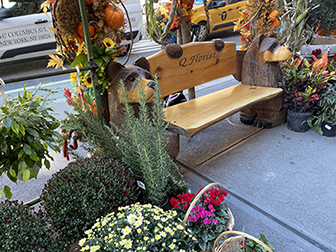 The social, as well as the economical, consequences of interwoven urban sidewalks are obvious when one thinks of the populations of people who walk to work and return home with grocery-shopping stops along the way. It can therefore be said that sidewalks play an important economic role in society inasmuch as those in commercially designated areas provide access to consumer-focused businesses and offer vantage points for viewing show windows that display merchandise or personal services. In addition to facilitating “window shopping,” sidewalks provide vantage points for observing the appearance of various vehicles within lanes allocated to curbside parking.
_
 Thus, for connoisseurs of the latest designs of various brands of new cars, a walk down a sidewalk can provide an experience akin to the one you might have on a visit to an automobile-dealer’s showroom, your imaginary personal seat behind the wheel, resulting in moments of envious delight.
As a pedestrian-mobility infrastructure of large cities and towns, sidewalks form a web of facilitated physical communication. Drawing-board maps depicting vehicular and pedestrian circulation via roads, streets, and sidewalks provides linear skeletons with anatomies that outline industrial, commercial and residential sectors, a lesson that I learned when I was a graduate student in Yale’s School of City Planning.
To experience the social benefit neighborhoods comprised of side-by-side yards, which is a fact that I know well because of my own upbringing in Alamo Heights, an independently incorporated- residential community at the northern edge of San Antonio, Texas.
_
As a New York City resident, I frequently walk along sidewalks both by necessity and by chance. For urbanites like me, movement through residential, commercial, educational, recreational, and cultural environments with a great deal of experiential pleasure based upon muscular control, visual sensation, smell inhalation, and ears open to sounds, including casual conversations among strangers regarding the weather, is well-worth a great deal of sidewalk perambulation. Moreover, serendipity is a force governing sidewalk observations, which makes this kind of exercise a pleasurable experience.
In a well-peopled environment such as that offered by certain urban sidewalks, overheard conversations become mini-dramas. In such cases, one may think of sidewalks as stages upon which visual and audible experiences serve as theatrical offerings and sidewalk benches provide audiences with front-row seats. I speak for others as well as myself when I say that I can’t take my eyes off of the small low-fenced soil beds near the edges of sidewalks, which invariably give me an appreciation of the rows of street trees growing in tree pits along sidewalk curbsides adjacent to streetscapes that includes storefronts, entrances to apartment buildings, and the stoops of brownstones.
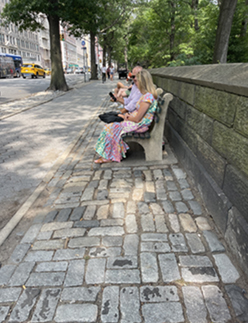 Thanks to sidewalks, on-foot mobility brings one to destinations of both convenience and pleasure: in my case, a local grocery store (Gristede’s), a delicatessen (Zabar’s), a pharmacy (Park West), several sidewalk-situated annexes to restaurants, and a variety of commercial enterprises with tempting window displays, including those of a seasonally-attuned florist. By a stroke of good luck, the sidewalk next to the apartment building in which I live takes me to the nearby street crossing at Central Park West and 81st Street in Manhattan where I can move toward the entrance to the pathway that merges my street-crossing steps with the ingeniously designed circulation system of Central Park.
As I ready myself to take my brief walk on the sidewalk in this direction, I like to admire well-groomed dogs-on-leashes and give smiling hellos to toddlers taking fast steps with determination and one hand cupped by that of a parent or care-giver, while also observing food-cart customers buying hot-dogs and cokes. Walking in introverted solitude down a sidewalk is something else, of course, and I occasionally find running through my head the childhood jingle, “Don’t step on the crack, or you’ll break your mother’s back,” as I step gingerly across the line marking the meeting of two identical slabs of a sidewalk’s limestone pavement.
Sidewalks, alas, are more than pedestrian amenities as one realizes when nearly hit by a rapidly pedaled bicycle in proximity, an inconsiderate nuisance that, unlike the patiently-pushed baby stroller, should be totally banned from sidewalks and strictly confined to streets.
_
During my adult life as an environmentally and historically oriented open-space advocate, park preservationist, and landscape-design historian, I feel privileged to have acquired friends whose academic careers and correlative publications have furthered an understanding of the meaning of place as a basic mental construct. An outstanding example in this regard is Kenneth Helphand, professor emeritus of Landscape Architecture at the University of Oregon, an inveterate sketch-book draftsman and watercolorist, who is the esteemed author of books exploring aspects of several types of landscape, including Yard, Street, Park: Design of Suburban Open Space, published in 1997.
I am now pleased to note that during its eighteen-year life span from 2003 to 2021 Kenneth Helphand was an invaluable member of the board of the Foundation for Landscape Studies, the platform that I created for landscape historians and advocates of open-space planning to oversee the organization’s activities, including the publication of the biannual journal Site/Lines.
Nowadays my platform for my own views on a variety of subjects, including ones that offer personal embraces with sites and subjects that can be encapsulated as diary entries that fall into the categories of poetry, news, reviews, and essays whose range is being extended to embrace contributions from others with whom I share place-based interests. I was therefore understandably pleased when, during a recent conversation over the phone with Professor Helphand (known as Kenny to his friends), I asked him if he would like to be a contributor to my online journal by writing an essay on a topic of his choice and he immediately offered me a recently written one on the subject of sidewalks.
As evident from prior postings of mine, I perceive my multiple series of journal entries as being receptacles for memories, and here in this current posting, wherein I see myself as hostess to the author, the reader will discover that the trajectory of Kenneth Helphand’s life has been from a Brooklyn boyhood to his current residency in the city of Eugene in the state of Oregon, while mine has been from a Texas girlhood to voluntary adult transplantation into what my mother once characterized as “the stony soil” of Manhattan. Although these courses in our respective life journeys have led us in opposite directions, sidewalks have been, and continue to be, a favorite form of locomotion for each of us. Who would think that for both Kenny and me sidewalks would chart a course of memories from youthful days to recognitions of current contentment? Let’s first hear what Kenny has to say on this subject.
_
I grew up in Brooklyn, New York. I walked to elementary school on sidewalks, a daily trek from 93rd street to PS 185 on 86th street. It was the beginning of what became a life-long habit of exploration and curiosity by varying my route passing through different blocks of the city’s checkerboard street layout. The sidewalks around our apartment building were also our playground. We played sidewalk games, I learned to ride a bike on the sidewalk, drew with chalk and recited the superstitious ditties associated with cracks in the sidewalk.
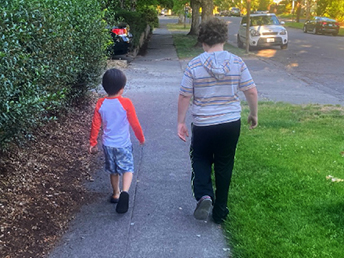
Two boys walking along a residential street in Eugene, Oregon, photograph by Kenneth Helphand.
Most of us would be surprised to know that In Eugene, alone, there are 772 miles of sidewalks (and 538 miles of streets)! The Eugene Parks Foundation is dedicated to improving our trails and, especially, to making connections between existing trails in order to complete a comprehensive system linking together the city’s open spaces. But a complete pedestrian system, a system for walking, already exists, that can be thought of as our urban trail network, the city’s sidewalks. For a hike there is often a plan, including such things as, boots, a backpack, a snack, and, of course, a route. Hikes are on trails whereas most walks are on sidewalks. A walk can be anywhere, anytime and any length such as, to the corner, around the block, or to a friend’s house. Sidewalks are everywhere, the street to one side, building and open spaces to the other. In addition, Eugene is the rare city that has gone out of its way to accommodate the blind and people using wheelchairs with 6982 sidewalk access ramps. This pedestrian system is right at your doorstep.
When we moved to Eugene a half century ago I drew a mile circle around the campus so I could walk to Oregon University where I taught landscape design courses within the School of Architecture and the Environment. My daily back-and-forth walks were never boring. I often altered my route, taking different streets, going through the campus or through Pioneer Cemetery. I monitored homes being remodeled, seasonal changes, what was in the little libraries, and cats who always seem to know exactly where the property line was. While walks may be relaxing, they also provide time to think. Working on an idea, I often stopped to write down thoughts. Looking backward through the lens of history, I realize that I had joined a venerable tradition. Thoreau’s philosophy was formed on his walks as he described in his classic essay, “Walking.” William Wordsworth’s poetry was inspired by his daily walks in the Lake District, often accompanied by his sister Dorothy.
Nowadays, my wife and I take routine walks that provide us with a time to be together without distractions, thereby giving us a daily opportunity to talk, reflect, make plans, and decide which coffee shop will be our destination. My mobile phone monitors the distance, but I now intuitively know the distances. Who do we see walking? Joggers, of course, it is Eugene, a city where fitness counts, but mostly it is folks walking their dogs who clearly know their route instinctively. Depending on the time of day there are also baby carriages and kids walking to and from school. Even so, I wish more folks walked. Of course, walking is good for one’s health, but it is also good for the community. An unanticipated benefit of Covid was that when we were unable to travel, people walked. and keeping a safe distance, people stopped to socialize. Think about your own walks. Too often we jump into the car for a short trip. Few of us have favorite rides to the supermarket, but we all have a favorite walk.
In her book Wanderlust: A History of Walking, Rebecca Solnit says, “Walkers are practitioners of the city for the city is made to be walked.” Eugene has a walk ability index of 77 % which means most errands can be accomplished on foot, but are they? We need to pay equal attention to our urban trails, the sidewalks, as we do to our wooded trail system. These humble sidewalks also require our attention. They should be safely maintained, improved where necessary, and recognized for the essential role the play in our community, for they literally tie us all together.
_
Inspired by the fact that Helphand’s memory bank contains scenes of youthful play as well as routine walks along sidewalks to and from school, I decided to break into my own memory bank and shake out the coins engraved with bas-reliefs of the sidewalks I encountered as a Texas girl growing up in Alamos Heights on the northern edge of San Antonio.
With regard to my sidewalk experiences as a girl, they are memorable mainly because I can still recall walking on sidewalks alongside house lots that ran parallel to streets of asphalt edged with concrete curbs and lawns embracing houses with front porches boasting fine-carved wooden rocking chairs where the inhabitants could, as was often the case with my grandparents, relax, contemplate, converse, and observe the passing cars and pedestrians while enjoying a sedentary reprieve from household responsibilities. Because there was a sidewalk running throughout the neighborhood where they lived in an apartment on the second floor of a 1920s house, I was often the happy walker on what might be termed urban nature trails with my grandfather, who would take me on brief excursions past contiguous lawns forming a greensward border to the sidewalk. I still admire in memory his pointing out to me the large white bud protruding from the crevice between the big shining green leaves of the phenomenal magnolia tree that was a showpiece in his neighbor’s lawn.
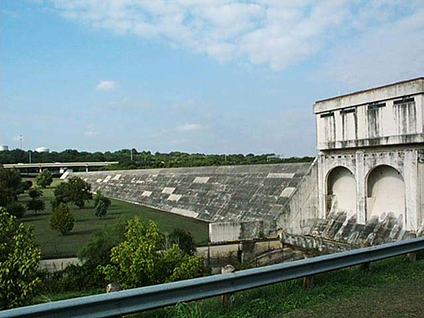
Olmos Dam, Austin, TX.
The most impressive contact with the local landscape adjacent to my grandparents’ home was to be found by looking over the stone wall of the Olmos-Dam-roadway that carries cars across the length of the eastern edge of the Olmos basin, a large flood-prone area built in the 1920s following the disastrous September 1921 San Antonio floods. (The Olmos dam itself is almost 2,000 feet in length and rises 65 feet above the reservoir, which has a surface area of 889 acres forming its flood-control pool.) These youthful walks with my grandfather along Crescent Street where he and my grandmother lived included stepping down from the sidewalk to street level and making a wide right-hand turn onto Patterson Avenue, which from the curbside provided me with my first contact with Southern Colonial architecture: an elegant mansion, which had been turned into a small hotel named the Argyle with a comfortable front porch on each of the two stories embraced by a façade composed of tall Grecian columns. While remaining a small hotel, the Argyle was turned into exclusive dining club and venue for special events in the 1950s.
I was personally the beneficiary of the Argyle’s renovation as a hospitable entertainment facility when my parents hosted a rehearsal dinner on the eve of my marriage on July 6, 1957, to Edward Barlow, my first husband and the father of my two children, Lisa Barlow and David Barlow.
_
Returning now to an earlier chapter of my life in which sidewalks played an important part of my daily routine, I will now describe my girlhood roller-skating “career.” From first through fourth grades during the early years of the second World War, I attended Cambridge Elementary School in Alamo Heights. While I enjoyed learning to read and to write and was proud of my good grades, I did not enjoy the lunchtime half-hour spent in the cafeteria eating the tuna-fish-on-stale-bread sandwiches necessitated because this was in a time of wartime austerity. Since the school was no more than a half-mile from my grandparents’ apartment and the streets to be traversed had sidewalks, my mother persuaded her mother to prepare nutritious well-cooked lunches for me on a daily basis. This meant that I had to trot with quick steps along a sequence of sidewalks to and from my grandparents’ apartment on Crescent Street. By this time I had learned how to balance myself on roller-skates and was confident, and even delighted, by the prospect of skating between school and what was a second home to me. I thereupon began my new dietary regime enthusiastically not only because of the delicious lunches and the graciousness of my grandmother who allowed me to include my best friend, Sarah Joe Robertson, as a guest at some of my noontime feasts, but also because of the sensation of flying through the air I received by roller-skating along some of the same sidewalks I knew from
Alas, this chapter of my self-propelled solo transportation career was marred because of the day when I failed to bring the skates I had just taken off my feet with me to my grandparents’ upstairs apartment and simply left them underneath a shrub next to the sidewalk that passed by the path leading up to the front door. I can still remember the sensation of panicky regret over my loss when I realized that a casual robbery had been committed and that in the future, if my teacher didn’t excuse me from class before the school’s cafeteria lunchtime, I would no longer be able to roller-skate on the sidewalk that led to a welcome invitation to sit down at the table next my grandmother’s fragrant kitchen.
_
Turning from memory lane back to the sidewalks of New York City, I cannot help but recollect the oeuvre of the inveterate high-society-fashion-fixated photographer Bill Cunningham (1929–2016), who once claimed, “The best fashion show is definitely on the street. Always has been, and always will be.” Therefore, perusal of this professional’s online portfolio will provide coins of gold from the memory banks of New Yorkers like me, who have reminiscences of an elderly gentleman with a large professional camera held to his eye while crouching on the sidewalk beside Fifth Avenue at 104th Street outside the gate to the Conservatory Garden in Central Park on the first Wednesday of the month of May each year and saying, “Hello, Doll!” to individual ladies with high-heals clacking on the surface of the sidewalk and smiles on their faces with bright lipstick-coated mouths and mascara-brushed eye-lashes beneath bespoke wide-brimmed, beribboned, and faux-flower-bedecked milliners’ hats. Thus did Bill Cunningham document for the Sunday section of The New York Times the sidewalk-associated high-society event known as the Central Park Conservancy’s annual Frederick Law Olmsted Award Luncheon, which has been sponsored by its high-society affiliated Women’s Committee for the past forty-seven years!
_
Beyond my memories of Bill Cunningham as a fashion-oriented sidewalk photographer, I have strong recollections of my high-society-aspiring mother who flew from San Antonio to New York every year for the FLO Luncheon. These trips, which lasted almost to the day of her death, were partly in order to display pride for her daughter’s presidency of the Central Park Conservancy and partly because she loved getting dressed in a beautiful designer-made suit. This brings me back in time to my recollections from childhood days of my mother’s almost annual trips to New York for shopping sprees on which she bought not only silk and satin evening clothes for herself but also for me cashmere sweaters and pleated skirts for everyday dressing and beautifully tailored suits for Sunday church-going attire. Later, when I was in my young adulthood as a new New Yorker, it was not surprising that my mother would frequently remind me, “You must look the part!” meaning that, since I was fundraising for the recently-born Central Park Conservancy, I needed to appear before wealthy prospective donors in a well-cut suit, smart blouse, high-heel-shoes, and a pair of fine, soft leather-gloves on my hands. Thus, with a touch of sentimentality, whenever I walk down the sidewalks embracing Fifth Avenue I like to have an imaginary spree of window shopping when I look at the gorgeously dressed manikins in the windows of Bonwit Teller, Sacks and other famously posh department stores. With no mother any longer to encourage me to adopt such consumer extravagance and no bank account to pay for a wardrobe of famous-designer clothes, I satisfy myself with a walk down the sidewalks of Columbus Avenue in my neighborhood, where I find brands that are reliable and friendly salespersons in stores with clean mirrored fitting rooms where it is pleasant to see a reflection of the well-clad figure that is the you-that-might -be. Even without purchasing anything, I find it simply a pleasant perambulation as I turn at the corner to return to my apartment in the southwest turret of the Beresford where I can look down through the windows on all sides at the great urban tapestry that is stitched together by streets and their adjacent sidewalks.
_
To avoid turning this journal posting into an incessant New-York-City-focused sidewalk song, I have reached once more into my memory bank to bring forth a sidewalk story set in the realm of my Texas girlhood. Thus, I am herewith asking my readers to join me in a run toward the hills.
“Don’t spoil the child,” is an admonition one still hears, but its prevalence during my youth was ubiquitous, and I realize now the extent to which my happy childhood was one of a parentally spoiled little girl whose family was ascending the escalator of financial comfort and recreational pleasure when my father bought a 979-acre ranch in the Texas Hill Country sixty miles north of San Antonio and four miles east of the small town of Johnson City, which today presents itself as a tourist attraction and allows free admission to the boyhood home of former United States president Lyndon Baines Johnson.
Four miles east of Johnson City, the ranch house that was built by my father’s construction-business workers is nestled within the embrace of two hillside ridges between which there is an ever-flowing creek named Honeycut after the family that originally settled the site. Having never gone dry, this spring-fed waterbody is for me today during my annual Texas homecomings a place of sentimental pilgrimage. Privately reminiscing, I see my young self alongside its banks looking for tadpoles and minnows and occasionally jumping in the creek for a bit of novice swimming. Such were my self-indulgently derived pleasures when I was a child who spent her weekends and summer vacation days drinking the sweet cup of recreational country life and enjoying an almost-daily walk along a utilitarian dirt road leading to the ranch’s two-mile-long flow of the water of Hunnicut Creek before it reaches its terminus in the basin of the Pedernales River.
_
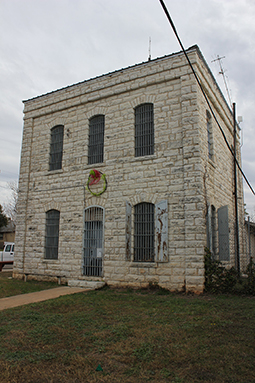
Old Blanco County Jail, Johnson City, TX.
Although, to my knowledge, taboo as far as roller-skating is concerned, but quite necessary as accommodations to the necessities of everyday life, including the purchase of groceries, beverages, detergents and other household supplies plus over-the-counter drugs, medications, tools and other hardware for home maintenance, Johnson City’s sidewalks simply provide a useful linkage between adjacent business establishments as well as the accessibility offered business patrons by curbside parking in front of commercial entrances. Still today, as in the years of my childhood, ordinary shopping and the occasional pleasures of window-shopping make the building and maintenance of sidewalks necessary components of the urban fabric that constitutes the weave of Johnson City’s street plan. I remember as a child walking on them during occasional trips from our ranch into town when my parents might give me free rein to get an ice-cream soda or buy a comic book among those being displayed on a rack at the entrance to the drugstore. My next memory is that of walking down the sidewalk to their parked car, which was then steered half-way around the handsome county courthouse before being pulled over to a pause at the curb of the sidewalk on the opposite side of the street. Getting out of the car and standing with upraised head, I liked to gaze with wide-eyed curiosity at the bars on the county jail while wondering who the invisible felons behind them might be, only to invariably learn there that there weren’t any.
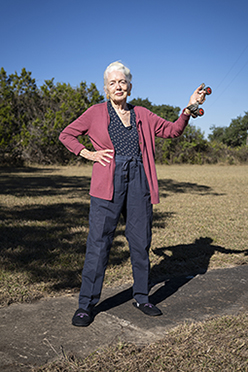 The building of a shuffleboard court next to the ranch house by my father’s construction-business employees was not the only recreational project they were ordered to perform for his family’s pleasure. As the eldest of three siblings, it happened that I became the sole beneficiary of the creation of a long curvilinear walkway embracing an old peach orchard next to the former ranch foreman’s house beyond which a broad green pasture rolls toward the hillside defining the eastern boundary of the ranch. I am amazed but not disappointed at this time in my life when I realize that my generous father had built just for a young girl with a desire to roller-skate wherever she found a smooth sidewalk, this curious ribbon of bright-yellowish concrete that appears like a huge snake moving toward the cattle-guard beneath gate that opens above the roadbed of the long dirt driveway leading up to the ranch house.
It can be taken for granted that I literally outgrew my favorite pastime and could no longer put on my foot the one remaining skate with measurements to embrace the sole of a ten-year-old girl’s shoe. This souvenir of my days of roller-skating can be found by me in the back of a bedroom closet on every visit I make to the family ranch, and I always cradle it in my hand and barely look down at my feet but hold it aloft as I stand on the sidewalk that curves around the outside of the peach orchard while running alongside the old cow pasture that becomes a blanket of bluebonnets every Spring.
Share









