August 24th, 2026
Naples and Rome with Ted Rogers
Although I consider myself to be an independent journal writer, whose travelogues speak only in my voice, when it came to one of the voyages to Italy that have been such an important part of my happy marriage to Ted Rogers, he took the reins. That the horse did not run away is obvious as one follows our double-saddled quadruped and Ted’s use of his favorite moniker for me, B7.
Ted’s Journal
Friday, June 29, 1990, Naples
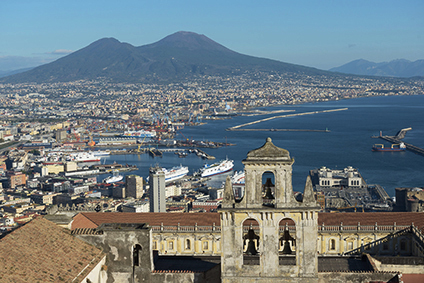
Looking at Vesuvius from Naples.
B7 and I are in Naples, Italy. I am sitting on the balcony of our room in the Excelsior Hotel looking directly at Vesuvius or, to be more precise, looking at two forms of Vesuvius, one that is partially blown away, and the other which has developed a pregnant tummy extending over the head of its former side walls.
No more than half of what Vesuvius used to be remains today. The eruption in 79 CE tore the mountain asunder, pulverized it, turned it into a plume in the sky, and as the metamorphosed cloud descended, packed Pompei with pumice, ash, and brimstone: a tragedy of such historical impact that it remains a primary link to preserved antiquity, a relationship spanning two thousand years, thereby providing the connective tissue of continuity going far back in the history of Athens and Crete.
The image of this most blue and tranquil bay that extends from my feet to the shores of the Vesuvius peninsula is only ruffled by the unnerving buzz of motorcycles and automobiles as they steam more rapidly and destructively than lava along the perimeter of the beautiful, crescent-shaped harbor. “Naples!” I think to myself. What a wonderful city I was to discover on this first step into Italy’s geographical boot.
Note: I am making a stab at an oral diary for a change. My most recently written entries covered my visit to San Francisco on a business trip from which I returned in the early hours of June 26.
June 26, 1990, New York City
After approximately three-and-a-half hours sleep, I got up, ran in Central Park, and was on my way to the office by 8:15 AM. I was accompanied by that nervous and uneasy feeling that always sets in when one knows that one will be out of touch for a number of days and must accomplish certain essentials in a very limited period of time. I have made a list of fifteen items, most of which are important to someone other than me: $600 in cash to be mailed to Martin (our gardener in Wainscott), along with a letter of credit written to a store in East Hampton so that Martin can buy the hedge clippers he needs for shrub pruning; three [sic] birthday cards purchased, written, and posted to my mother (Leona Rogers) and Betty Browning (mother of B7), and various checks for bill payments and so on.
By twelve I find I have accomplished most of what I set out to do and can, in fact, be home to pack by 2:30 PM. I make a decision to take as little as possible on a trip that will last ten days and includes both Naples and Rome (Napoli and Roma as B7, who is teaching herself Italian, would say). One suit, two pairs of cotton slacks, a sports coat, several ties, and other necessities all fit in one hang-up bag. My briefcase is loaded, for one of the first times in my life, not with work but with books and utility items. One other small black bag carries my shaving kit, skin lotion, and more books.
B7 arrives home around 2:30. She has already packed. Our beloved housekeeper Aida prepares a spur-of-the-moment salad for me since I forgot to have my lunch today, and we are off to Kennedy Airport by 4 PM. My recently formed business, America Industrial Partners, closed today on $30 million dollars, bringing our fund to $120 million and putting us over our break-even point in terms of income. We can now begin to build the type of organization we need to have in order to conduct a profitable business. It is a happy way to begin a vacation.
Kennedy Airport and Alitalia Airlines are a madhouse, good preparation for Rome and Naples. We are traveling Alitalia first-class – a term I don’t understand until we board the Boeing 747 and ascend the spiral staircase to the forward bubble. Here are twelve very comfortable seats, six of which will be occupied during the flight to Rome.
B7 immediately gloms onto my copy of Edith Hamilton’s Mythology. After a mediocre dinner, B7 flakes out, and I continue to read The Mycenaeans by Lord William Taylor. What a thrill to imagine this monumental civilization, with its cyclopean structures, brave nobles, and rich art.
I manage to grab about two hours of sleep. Before we know it, we are descending across the coast of Italy, readying for landing in Rome. The entire flight has taken approximately seven hours.
July 27, 1990, Rome and Naples
At 8 AM the Rome airport is fully awake. Our bags arrive intact and promptly. We are met by our driver, who will whisk us down the coast of Italy to Naples. Along the way, we will stop at Sperlonga and view some of the antiquities that were unearthed there, a gift of the late 1960s when a tunnel was blasted through a mountainside. What a treat Sperlonga turns out to be! This is the very grotto where Sejanus saved Tiberius by throwing himself over the emperor and supporting himself on his hands and knees in the grotto, which began to crumble while they were dining. Tiberius, who had relied on Sejanus for administrative purposes back in Rome, was now bonded with him ever more strongly. But, alas, the bond showed the tensile strength of political alliances. When the chips were down some years later, in 31 CE, Sejanus was charged with treason, jailed, strangled, and his body torn to pieces by the mob.
Sejanus’s death and the fear of the German guards brought Claudius – gentle, impediment-ridden, misshapen Claudius the Divine—to the head of the Roman Empire when Tiberius and his successor, briefly reigning Gaius, died. Then, “While the Senate deliberated, the Praetorian Guards resolved,” to quote Gibbon, and Claudius was emperor.
It is this rich piece of Roman history that echoes from the grotto as we stand looking into it. The foreground is a maze of fish-retaining tanks and artificial lagoons, which had been stocked with alligators for Tiberius’s entertainment. On our right, as we look into the grotto, we see the location of Ulysses’ ship, as well as the site of the monumental statue of Polythemus being blinded by Ulysses and his men. To the right of the grotto, on the beach, brown Romans toast themselves: the ladies in one-piece bikinis, the men in one-piece bikinis, and the children in no pieces at all.
Inside the adjacent museum, which is about as sloppily kept and maintained as one can imagine, we feast our eyes on reconstructed and reassembled fragments of antiquities that once looked upon lounging Roman courtiers as they retrieved their meals, which had been floated to the water triclinia by slaves. One can only imagine what else those silent works of art absorbed in the years of Tiberius’s self-exile from Rome.
As I dictate these words, a high-power motorboat has just steamed out of the bay in front of me. It looks very much like one of our Miami drug-running vessels.
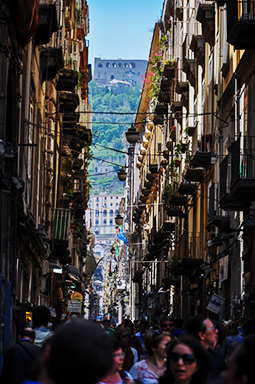
Spaccanapoli, Via dei Tribunali, Naples.
Following Sperlonga, we veer to the west and pick up the Autostrada to Napoli. Our mid-sized Mercedes grows to limousine proportions upon entering the city. Locusts of cars and gnats of vespas swarm about us as we make our way to the Excelsior Hotel. After unpacking and shunning the comfortable but bland offering of the hotel dining room, B7 and I lunch at the trattoria around the corner. The trattoria is actually a pizzeria, but pizza is not being served because it is after three o’clock in the afternoon. We therefore order spaghetti and mineral water. Then a walk through the city and into the section called Spaccanapoli, “the broken city.” This is a crosshatch of small blocks laid out in almost honeycomb fashion by the Greeks some two thousand years ago.
As we finish our walk through Spaccanapoli, we find ourselves at the Church of Jesus Nuovo and the nearby Santa Chiara, where we are unexpected participants in two wedding ceremonies. The distinguishing characteristic of both ceremonies is not the gulf of contrast between the two churches, one being Angevin in design, absolutely plain and void of decoration, with a flat-topped roof, and the other being Roman rococo and baroque in style. Rather, it is the similarity of the two services. They are both being covered by hired television and still photographers. The ceremonies were not truly ceremonies, but rather exhibits to be captured on tape and only there to live. The moment is not the moment but a future frozen eternity. The relationship of the bride and groom are not to each other but to the lens and what would be, not what was. Are we so alienated? Must emotion only live when transmitted to us by an electronic God? God is not dead; He lives in silicon chips, woofers, tweeters, and cathode ray tubes.
We return to the hotel around six o’clock in order to shower and ready ourselves for an outdoor evening concert to be performed at the Museo Villa Pignatelli beginning at 9 PM. I have to pry B7 out. She is jet-lagged and fighting off a cold. For some time, I think she will stay in the room and not attend the concert, but she rallies, and we grab a taxi to the museum, where we have a lovely evening listening to chamber music by Beethoven, Gounod, and Mozart. The faces of the culturally sensitive Italian audience are sharp, in contrast to those faces we saw on the streets of Spaccanapoli a few hours ago.
B7 characterizes Napoli as raffish, and it is. And, although there is obvious corruption here, I harbor no sinister feelings akin to those that accompany me through the streets of New York. Somehow, it’s not the sinister corruption that one sees elsewhere. Here in Naples, pickpockets and con artists have softer, more languid demeanors but, nevertheless, they are abundant, and they are always on the lookout for tourists such as us. The streets are dirty, but no dirtier than those of New York. The traffic in Naples is bad, but no worse than New York’s. The only differentiating characteristic in the traffic is that here there do not seem to be any rules whatsoever. Red lights appear, although they might as well not exist. Directions marked on streets are meaningless if someone wishes to go in the opposite direction. Motorcycles careen down the street at imprudent speeds, while pedestrians dart around in between moving cars and thus, on every street corner, dare death.
The concierge at our hotel had told us that we would have no trouble getting a taxi after the concert. I told B7 at the time that this was the standard, good-mannered advice that most concierges would give, meaning that we had received a respectful lie. In fact, we did take a pleasantly balmy stroll back to the hotel, where I am now, at 12:45 AM, in bed restoring and regenerating my energies for tomorrow.
Thursday, June 28, 1990, Naples
Up and out the door at 6 AM for a run along the crescent lip of Napoli Bay. Legs heavy, the streets already beginning to clog with morning traffic. Using a canine moniker for my legs, I must say that my dogs do not seem to have any doggy spirit within them. They flop. They do not lie down, they pool. The females all seem to have protruding teats. Their eyes are opaque and void of affection, and their tails deny the fact that they are dogs. My round-trip takes forty-some minutes and is not pleasant.
After a shower and breakfast on the terrace, we are off to the National Museum where I receive my first real taste of actual Greek wall paintings, followed by room after room of faithful but mechanical Roman copies of Greek statuary. We spend almost four hours in the museum and then have to zip to get to Shirley Hazard and Francis Steegmuller’s apartment on the hillside of Naples, overlooking the bay toward Capri, with Vesuvius standing silent watch to the south. Francis and Shirley also have a flat on Capri, but Francis found his literary research required much time at the library, and the transit time between the island of Capri and Naples took so long that efficiency required something in Naples.
What a pair they are! Shirley is bright as a button, the more voluble conversationalist of the two. Francis, extremely sensitive, humorous, clearly in love with Shirley. In spite of Shirley’s remarkable record as an author, and in spite of the critical acclaim of her novels, it is Francis whose work I most admire. His sensitive rendering of Flaubert’s visit to Egypt, and his outstanding translation of Madame Bovary set him apart. He has just finished a new book and showed us his “baby” nestled in a Kodak slide box, paper clipped together, chapter after chapter of typed copy with scribbled margin notes. Francis writes on a pad and then quickly transcribes with his small, portable Remington typewriter.
The typewriter sits on a desk facing a windowless wall that shields him from the sirens of distraction in the Bay of Capri.
The apartment is absolutely delightful: cheerful, minimal in furnishing, possessing a fine library, and a balcony running the whole length. The heat of the day precludes our sitting out on it until about four o’clock in the afternoon. By that hour, under the colorful bougainvillea vines, one enjoys looking out at the Bay of Naples, beguiled by subsurface shadows of old Greek architecture now fully possessed by the sea; children messing around with boats, cavorting in the water, and living forever; with Capri in the distance and so visible on a clear day that one can see the campanile and easily read the face of the clock with binoculars.
We pull a table out into the area that serves as Francis’s office, and place four chairs around it. I sit in his typing chair and enjoy a five-course lunch that extended by conversation lasts for over three hours. Shirley dominates the conversation concerning Italian national culture; the plot of her next novel, with autobiographical characters, is set in New Zealand and has patches and snatches of her life bouncing around the Orient as a young girl with her father. Patient, kind Francis is finishing yet another book and readying himself for still another. His books, which center around the interpretation of correspondence and, in the process, backlight the time and society of the protagonists, are written with tenderness, artistry, insight, and intellect.
After lunch we make a beeline back to the Excelsior Hotel in order to change our clothes, since we will attend a performance of Madame Butterfly this evening.
Ten minutes to six o’clock finds us climbing the stairs of the Theater Royal and entering a very sound baroque opera house. All of its flamboyant character, brass boldness, and overstatement are embodied in the royal box at the rear. The rest of the opera house has been renovated with lovely seats and is human in scale. One does not feel the need for a Zeffirelli spectacle, but rather for good singing and acting that relate directly to the audience. Butterfly is sung by a Japanese singer named Yamashita, who is obviously too old for the role, but she sings well and acts with grace. One set is used for the entire performance: a highly arched and lovely Japanese bridge and a foreshortened, flat-bottomed vessel of a type typical of China and the East Indies. B7 and I enjoy the performance greatly in the third row on the aisle.
After the performance, which ended at about 9:20 PM, Salvatore, the part-time chauffeur for Shirley and Francis and, with their generous behest, ours for the rest of our visit to Naples, drops us off at a four-star restaurant where we celebrate our third anniversary with mineral water and some of the best antipasti I have ever eaten in my life.
(I am using the hotel’s typewriter since, with the above words, our room’s electricity failed, leaving Ted and me (B7) to continue our joint narrative, which was left in limbo until the cable could be plugged correctly into the wall.)
Saturday, July 30, 1990, Naples and Rome
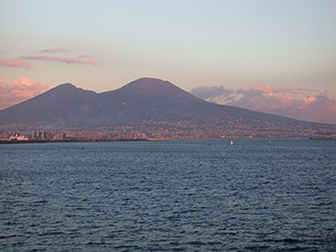
Vesuvius at sunset.
It is early evening, and I am again seated on our hotel balcony watching the sun turn Vesuvius pink and enjoying a nice cup of English tea. It is difficult to remain calm with traffic noises assailing you from every side. For example, there are burglar sirens announcing that the car owner has forgotten to turn the safety system off, or someone is actually burglarizing a car and is annoyed by the high-pitched whine and buzz of motorized bicycles. And yet, it is very difficult to be upset. Tranquility of the eyes overcomes the assault on the ears as I watch the slow-moving water traffic ply its way out and in of the Bay of Naples.
I was up this morning by 5:15 AM and out running by a little before six. What a difference Saturday makes. The traffic is not nearly as heavy, the morning seems cooler in response to an absence of automobiles, and I feel stronger and quicker. As I run, I turn over my recent trip to San Francisco, focusing particularly upon the Gay Pride Parade led by Dykes on Bikes, which ended with a parade of Dykes on Trikes. (Dykes on Trikes are usually elderly lesbians riding senior-citizen tricycles, while the lead-off dykes in the pack give themselves free rein on Harley-Davidson motorcycles.) What a strange and sad situation, and how society loses by forcing this creative, energetic, and intellectual portion of our community to expend such energy in an effort to proclaim their right to a welcome presence in our social system! Seen historically, lesbians actually fielded an army of homosexuals in battle more than once. The combination of genetic perspective and fortuity gives rise to unusually creative contributions to society. The degradation of having to parade as freaks is one of the gross injustices of our time.
Returning along this golden perimeter, sidestepping man’s filth and dodging to avoid the city-choking automobiles, my mind turns again to the two Italian weddings we observed yesterday and their omnipresent television cameras. As a loving married couple, B7 and I understand that, better than lost love, is love found and kept. Both of us thus have an aversion to many of today’s sexual prejudices and esteem many gay friends of both sexes.
B7’s penchant for combined urban planning and landscape design, plus her study of Greek and Roman antiquity, as well as her habit of philosophizing, gives me the opportunity to turn over the writing of this journal entry to her.
Overall, social systems and urban designs are governed by policies and their effects, as is apparent in the following observations Ted and I made on our travels throughout Italy’s historically well-fitting “walking boot.” In the antiquity of Greece, the public space took on a sacred aspect. We see this in the collection of architecturally rich spaces in Pompeii. The Greek polis confirms the healthy aspects of urbanization and the tremendous creativity that it can unleash. In early Athens, both rich and poor were housed in small, modest, unassuming spaces, and it was in the public spaces that people realized their true minds and souls.
By contrast, in the universal modern world, governed by multiple legislative and elective power structures focused on efficiency, the attributes of the Greek agora are unrealized. Today, in most countries, urbanization and suburbanization have made the distance between rich and poor more visible than ever before. Lost humanism and, with the exception of woke ideology, the vanished sense of spiritual and societal bonds, suggest that the public space is, for the most part, far from being the uplifting and intellectually challenging place of widely accepted social interaction that it was in the years we call classical antiquity. Slowly, as government became more remote from its subjects, the alienated individual turned more to their private life for satisfaction and concentrated on their personal space.
Now that B7 has given our readers the lowdown on current events and the background for understanding Pompeii and Herculaneum and other magnificent Greek architectural landmarks within the orbit of Magna Graecia, we are ready to move forward on our trip to Paestum on the coast of the Tyrrhenian Sea. After our breakfast on the hotel patio this morning, we set off on our drive, traveling for about an hour on the Autostrada to just past Salerno and then going south to Paestum. This marvelous city was rediscovered around 650 BCE, and now B7 and I are uplifted and overwhelmed by our first sight of Greek ruins.
First, we slip into the museum, a treat in itself, with both red- and black-figure painting. Metopes are arranged on a shelf about fifteen feet above floor level. They depict Homeric scenes, preserved from the Temple of Hera. Small terracotta figures enchant both of us, the delicacy of jewelry, draped fabric, safety pins, hair combs, and mirrors reminding us of eternal vanity.
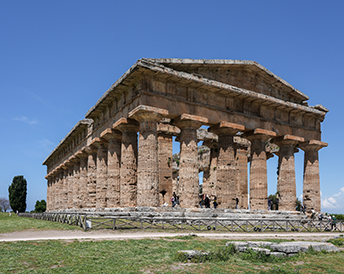
Temple of Poseidon, Paestum.
After leaving the museum, we go to what we believe to be the smallest Temple of Hera, but find we are turned around and actually have begun with the smallest of the temples, that of the goddess of grain. It takes us some time to unravel our position on the map since we are starting from altogether the wrong spot. However, once we get our bearings, the layout of the ancient city becomes not only sensible but brilliant. The gymnasium, baths, amphitheater, agora, and forum all blend to give the sort of public space necessary to humanize the city. However, it is truly the temples that thrill and overwhelm us. The Temple of Poseidon sits on a stylobate of three steps. It is sixty meters long by twenty-four meters wide – and thrilling! Its massive columns, its cella with two tiers of columns, and its astounding state of preservation begin to transport us back in time. One end of the temple frames views of the mountain, while the other, at the time of its construction, offered a view of the ocean in the distance. Standing inside the temple while enjoying the cool breeze on what has turned out to be a very warm day, one can imagine Shelley’s delight when he visited the site. Perhaps this is what caused the great poet to remark, “We are all Greeks.”
The Temple of Hera, also called the Basilica, has no basilica. It was divided down the center by a row of seven columns, three of which remain. By itself, it is bewitching, and it is only by comparison that it suffers.
Before leaving, we re-enter the museum, remembering that we have not seen the painting known as “The Tomb of the Diver.” How fortunate that we do return, for we have missed a whole section of the museum, containing tombs from the Necropolis discovered nearby. The most interesting works are the Greek mural paintings of around 480 BCE, which feature the diver. Other scenes are of a symposium attended by young men, one or two of whom play the lyre and another the flute. Two others, obvious lovers, are deep in conversation, as one tousles the hair of the other and looks admiringly at his friend.
We buy a bottle of water to quench our thirst and are off to Minori, where we lunch unsatisfactorily at an outdoor beachfront restaurant with a waiter who insists on depriving B7 of her right to speak Italian. After lunch and a false start, due to B7’s misplaced straw hat, we visit a recently dug villa in Minori that contains one of the larger nymphaea, but unfortunately we are unable to get a closer look since it is still in the digging process. We do, however, identify several old anchors but generally are disappointed in the visit.
From Minori we travel to Amalfi where we visit the Piazza del Duomo. This church is approached by a flight of stairs that has been photographed time and again. We enter and are treated to another Roman wedding with grinding television cameras and snapping Kodaks. Behind the church is a delightful cloister, scarred only by a platform in the center of its garden holding a grand piano and an “on-duty” cat. B7 does manage to get some photographs, not only of the garden but also of the cat and piano. The double-columned perimeter with the narrow arched spacings seems typical of Siratian architecture. (Who the hell are the Saratians? I will have to bone up. It is really hard not to feel stupid in this historically rich world of ours.)
We leave Amalfi for Ravello, where we visit the Villa Rufola. This is the garden where Wagner found inspiration for the Magic Garden of Klingsor in Parsifal. It’s not hard to see why: A beautiful, well-laid-out, tightly designed garden among antiquities, with one of the most breathtaking views of the ocean and mountains I have ever seen. There are allées, benches, beautiful trees, fountains and grotto-like structures . . .
(Poor typewriting technology reigns: my typewriter tape lapses here.)
The following words can be considered a rumination on a conversation with Shirley Hazard: Two thousand years out of several millions of human existence is like a blink. She took issue with this and said we had had more than enough time to work it out. She was quite disappointed at our lack of progress. Francis, on the other hand, is more tolerant, patient, and more interested in the sensitivity of his relationship with Shirley than in the coming of Valhalla. It is now a little after 9:30 PM, and I must turn on the television – must! must! must! I am rooting for Italy!
It is 8:45 AM. The sun has just swept across the sky and hidden itself behind the morning clouds. I am seated on a bench in the garden of the Villa Aurelia (the historic guest house of the American Academy of Rome, a perk that B7, with her ties to the officers of this prestigious organization, deserves). I am now overlooking a reflecting pool, watching some golden carp flit in and out among the floating water lilies that break the surface. Water drips from an urn in the center of the pool, and bird songs surround me from the pollarded trees. We arrived yesterday evening at about 6 PM, but before I go further, let me go back and catch up on the evening of June 30.
Saturday, June 30, 1990, Naples
After I have been dictating on the balcony for about half an hour, B7 and I dress and stroll to our favorite trattoria. Tonight is the night that Italy is playing Ireland at 9 PM. (Note how much I really know about soccer; the last time I mentioned this, I had Italy playing Yugoslavia.) This evening the streets of Napoli are eerie. Hardly a car or sound disturbs the deserted urban landscape. As we pass open windows along the way to the trattoria, we hear the same voice and see the same ghostly flickers on the wall.
In the trattoria, the large television set is on, and most of the tables are taken by Italians, for once forgoing animated conversation except for expressions of support or outrage at what is taking place on the screen above their heads. I’m instantly caught up in the fever and become an avid, rabid, rip-roaring fan of Italy in its electronic conquest of the Irish team. At some point in the evening, the front door of the trattoria opens and in walks a familiar face. At first, I cannot place her, yet I notice that she is a large, heavyset, matronly woman in her early forties. She moves quietly back to the cashier’s cage, chin uplifted, smoke smoldering from nostrils and mouth. Recognition becomes complete. She is the hooker whom B7 has seen working the nearby corner every night. The power of sport subjugates not only sex: Italy wins. Justice triumphs. The world is again, if just temporarily, full of meaning, spirituality, and bliss.
At eleven, B7 and I wander back to the Excelsior. The streets are again alive with traffic and girls back on the beat.
A brief read. In bed by 12:30 AM.
Sunday, July 1, 1990, Naples
Up and out on the streets for a run at 5:30 AM. Only public transportation is functioning. Sunday, a day of rest, has arrived, and the morning is probably being taken by many Neapolitans as their just rewards for their breathtaking participation with, and emotional support of, the Italian team. My legs still feel heavy and, for some reason, I feel more and more out of shape every day.
Back to the hotel and packing for our departure. We are off by eight for the Palazzo Reale at Caserta, a famous place where there is an Italian garden that B7 is very anxious to see. It is quite impressive and thought-provoking in that this eighteenth-century garden’s design has been borrowed from the French, who in turn had borrowed it from the Italians several centuries before. Like currency exchanged many times, its value has diminished. Its state of maintenance probably contributes to our feelings. There are interesting water features and quite complicated problems of hydrology that have been faced and solved. The cataracts at the end of the garden are really quite spectacular.
The heat of the day begins to take its toll. B7 and I grab a bus back from the cataracts instead of walking the one-mile return route. We then tour the great house itself, which impresses us with its size and grandeur but not its design sensitivity. A little after noon we are on our way to Nimi and our meeting with the goddess Diana. Nimi is a small, out-of-the-way town perched on the lip of a volcanic crater, a lip that serves as the circular frame for Diana’s mirror: a beautiful, round lake, some thousand feet below the crater’s rim, pooled in the center of steeply sloping woodlands.
We take lunch at 2:30 at a restaurant that Francis Steegmuller has recommended. We are the only Americans, and in fact, we are the only tourists among the Sunday crowd. B7 objects to the flags and banners that line the restaurant walls and the lip of the crater on the other side of the street. She is right: In spite of their gay animation, banners detract from the natural beauty of a place.
After a couple of abortive tries, we find the entrance to the lake: a steep, deep-sloping drive, wide enough for one car although, miraculously, several cars do pass us on the way down. This is the lake of Diana’s temple. It is the lake of the priest who must constantly stay vigilant, for he can only be replaced in a duel to the death by a slave capable of breaking a branch from the sacred tree: the Golden Bough. A life of anxiety and vigilance with no rest and no enjoyment of the kingly, priestly position. We’re reminded of Theseus’s return journey to Athens, his encounter with the minotaur, and his brief rule as king of a matriarchy, in Mary Renault’s The King Must Die.
On Lake Nimi, the Emperor Tiberius built two massive barges for use in the entertainment of his guests and as floating palaces. These gigantic vessels plied this lake in the first century C.E. Sunken over the ages, they were recovered and restored in the first half of the twentieth century. Sadly, they were burned for no reason other than spite on the part of coarse, mean-spirited Germans as they relinquished their positions to the Allies in 1945. A world treasure destroyed by a monstrous society! I have seen this behavior before in Warsaw, where all of the treasured buildings of old can now be found with drilled dynamite holes in them. Only lack of time prevented charges from being set and the Polish heritage blasted to oblivion. And, as I sit here in this Roman garden, listening to the birds, watching the fish, enjoying the beauty of trees in the warming summer breeze, this Teutonic state is being reassembled, much to the joy of television commentators throughout the United States.
We drive around the rim of the lake but are unable to find Diana’s sanctuary. No matter, the drive is worth it and, as we take the steep, difficult road out of the crater, we pass through an enchanted forest that creates the impression that Diana probably still holds court among the sacred trees.
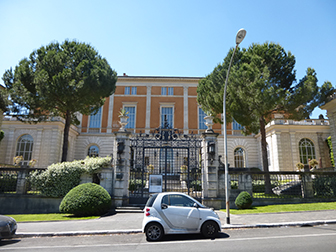
American Academy, Rome.
We arrive at the American Academy at approximately 6 PM and are delighted to see its fine architectural structure. Lovely academy: Closed from the streets by a wall and cast-iron gates, it is approached by a circular drive surrounded by a pleasant, well- maintained garden. Up the steps and into an entryway that is wide, high, and expansive, flanked by two spouting water wells probably transported here from some Roman village, the sound of the water offering a pleasant welcome. Up a flight of stairs, we meet an interior courtyard surrounded by a lovely, three-story building.
The gatekeeper of the academy escorts us to the Villa Aurelia, the landmark building that serves as a guest house for special visitors. It is up the street some three or four hundred meters, adjacent to the Arch of Garibaldi. After turning over a ring with four keys, the gatekeeper pulls the entry door open, and we find ourselves in a spacious villa, cooled by afternoon breezes. Our room, approximately thirty feet by fifteen feet in size, is two stories up. Generous in size and comfortable, it has two spacious closets; a large, newly built and airy bathroom; and three shuttered windows which open to display a back garden. We instantly feel at home and delighted.
I return to the car waiting outside and settle with our chauffeur: a thousand-dollar bill for three days of driving. The price was worth it for being met at the Rome airport, having the lovely day at the Greek ruins, and arriving back in Rome in one piece.
We rest ourselves on the comfortable beds in our room, and then do a little exploring of the rest of the gracious and welcoming house. B7 tells me that the villa had benefited by its interior design being accomplished by the famous Mark Hampton. She says this somewhat apologetically. I understand, since she intuits that somehow the thought of Mark Hampton violates my less-than high-society sense of place. But it shouldn’t. The villa is sensitively and tastefully decorated, and the use of color is exceptional.
I shower. The bathroom is a delight. Refreshed, we take a cab to the Capitoline Museum in the hope of spending a good amount of time there and then attending the outdoor concert in the piazza. Both hopes are dashed. The museum has closed for the evening, and there is not to be any concert. We wander around the plaza, with its copy of the Marcus Aurelius equestrian statue in the center; ponder whether the facades of the buildings by Michelangelo were stage sets created only for the royal visit and with no depth of meaning. No matter for us. They are beautiful, and they move me each time I see them. We practice reading Roman numerals as well as our Latin on some of the plaques in the square. . . . Too bad that the fresco depicting the noble, eighteenth-century Senate building is the public ass-kissing of Emanuel II to the point of nausea. The plaque served better as an uninterrupted Latin mystery.
B7 and I sit on a bench in the Senate and watch the sun dip below the rooftops of Rome. We then set out to find the restaurant Antiqua Roma, which we do, only to be turned away because there is no space for diners like us outdoors. We grab a cab for the Via Garibaldi and a restaurant recommended in our faithful, if old, Roman guidebook. It, unfortunately, proves to be a bust. B7 and I are unhappy without a particularly good plan and with unfamiliar territory.
In the restaurant, we find a party, mostly males, consisting of about thirty folks around a U-shaped table facing a large television set that offers up in living color the Cameroon – England soccer match. I am instantly converted into an ambivalent fan, wanting Cameroon to win because of their underdog situation, being as they are victims of bias from the English. There is no question that the Italians and French at the table are all in favor of the Cameroonians. While we are eating, Cameroon scores a goal to take the lead; then is overtaken and tied by an English goal. Cameroon scores another goal to move ahead; we finish dinner, call a taxi, and, while waiting for the taxi, I stroll down the street and watch the game through the open window in an apartment building.
A taxi takes us to the academy, where I find the game being broadcast on the television in the caretaker’s house. B7 returns to the villa and goes to bed while I walk around outside of the gatekeeper’s house and watch the game through the barred window. The gatekeeper takes pity on me, gets out a plan of the American Academy, and locates a room in which there might be a television set.
I enter the academy (it is now 10:30 PM) and, after climbing two flights of stairs and moving to the rear through dormitory spaces, I see in front of me the eerie flickering light that can only mean one thing. Interestingly enough, there is not much sound emanating from the crowded, dark room at the end of the corridor, only the intermittent and very sparse commentary of the European sportscaster. Here a room crowded with academic fellows mixed fifty – fifty, men and women, young men and women working on their doctoral dissertations in Roman art, classical Greek studies, landscape architecture, architecture, and humanities all collected together to watch the soccer match in silence. From the low murmurs, it is apparent that this crowd backs England and not the Cameroonians. The soccer match has degenerated into a series of gross fouls on the part of both teams, but most noticeably on the part of the Cameroonian players. The game ends with England the victor by one goal, and any racial biases that I might instinctively harbor are soothed by the exhibition of poor sportsmanship by the Cameroonian team.
Back to the villa where B7 in her nightclothes is reading, I join her in bed slightly after midnight.
Monday, July 2, 1990, Villa Aurelia, Rome
Up this morning at 5:45 AM to find a good running spot. The large park, which comprises the Villa Pamphili, proves to be elusive, but the worst problem to solve is that of crossing the street without being killed. Traffic is already heavy at this hour, and my brain not too swift. I finally find the entrance to the park and enjoy a nice but heavy trot through it.
While running, my thoughts shift between my problem back home as chairman of the New York City Ballet and thoughts of the wonderful public relations job done by the Tudor kings after the defeat of Richard III. Poor Richard! What a bum rap he has taken through the ages and mostly to justify the ascension of the Tudors to the throne!
B7 waves to me as she returns from the academy. It’s 10 AM and time to begin another Roman day. As I stroll up from the pool towards the villa, it occurs to me that Henry Tudor had his nerve claiming descent from Cadwallader, the mythical King of Wales, to justify his right to the throne.
Monday, July 2, 1990, Villa Aurelia, Rome, 8 PM
Back on my bench in the garden of the Villa Aurelia. It is cooling quickly. The sun angles downward, making lacework of the trees. Two large pigeons have joined me, staring with cocked heads from the water-filled urn in the center of the pool. Swallows swoop and soar between the trees. Beautiful to watch, but if you are a bug, beware!
Today was an extremely interesting day. A cloister day. We began by visiting the Church of Saint John Lateran. Here we found a remarkable cloister that is distinguished by its pairs of slender columns – some twisted, some woven, some smooth – many inlaid with beautiful gold-and-blue-and-red mosaics. The interior frieze is also decorated with intricate mosaic work and regularly punctuated with alternating, protruding sculptural representations of men’s faces and animal snouts. In the spaces between the arches, there are more somewhat comical representations of snouts and male, visages. At the bases of the irregularly spaced columns, there are carvings of small animals. We are disappointed to see that the garden in the center of the cloister is not particularly well maintained. We comment on an animation that is full of surprises and also take note of the fact that some of the columns are irregularly spaced.
Saint Paul Outside the Walls, which was the next stop on our cloister tour, has less bizarre sculptural adornment since the main focus of interest here is a well-tended rose garden. This and the cloister at Saint John Lateran were finished at about the same time, between 1225 and 1230. This cloister is much more serene and peaceful. One would not tire of meditating or contemplating in its confines. The roses are stunning and show obvious signs of sound care and good maintenance.
We were now ready for lunch and therefore walked over to the Antiqua Romain, the restaurant that had not had room for us last night. Success! What a treat! I have carpaccio and an excellent salad with buffalo mozzarella, fresh cold beans, golden olive oil, and asparagus, while B7 has, in addition to carpaccio, the most delicious grilled mushrooms I have ever tasted. We finish the meal with coffee and fresh cherries served in a bowl of ice water. I read to B7 a bit of Shakespeare – enough to whet her interest.
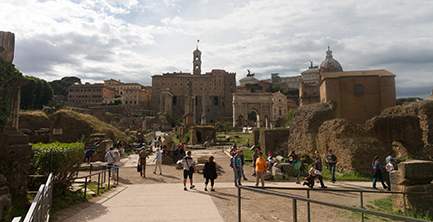
The Forum, Rome.
After lunch we walk in what we believe to be the direction of the Palatine Hill in order to take a walk in the Farnese Gardens. Our faulty memory of seeing this site and a current lack of a sense of direction cause us to walk resolutely the longest way to get to the entrance by going down the Circus Maximus, around behind the Forum, and finally up to the top of the Palatine Hill, where we walk toward the garden that was planted over the palace of Tiberius (Julius Caesar Augustus), the second Roman emperor. We stop to enjoy the view from this delightful viewpoint overlooking the Forum and the entire area of the current excavation. B7 observes that we are walking through the oldest part of Rome, which at one time was the busiest and noisiest part of the city. It now serves as a shelter from the chaotic traffic and hustle of the city. Down the stairs from the aviary, we pass a nymphaeum. It reminds us that, in addition to carnal delights, the Romans knew a thing or two about air conditioning.
It is now about 4 PM and time to visit Santi Quarto Coronati, which opens at 4:30. We hail a taxi and encounter a perfectly lovely face at the wheel. It is the sort of face that one knows will be thoughtful and kind to others. There is an innocence and care in the eyes, and although all I can see is a stubble of beard on the face, there is a sense of cleanliness and principled order. After some maneuvering and question asking, we find the Quatro Coronati. It turns out to be the treat of the day. This old church, constructed in 900 CE and reconstructed more than once but still maintaining its original character, contains one of the most delightful cloisters we are ever to see. Simple, completed approximately one hundred years before the other two we have visited today, it has obvious evidence of good care. A sister of the Augustinian Order exudes beauty and purity as she attends to the task of sweeping and straightening up. B7 does her the honor of not photographing her and thereby not reducing her to the status of a quaint person for local color, but rather respecting her dedication by purposely avoiding the inclusion of her picture in the B7 Italian photography bank, which grows richer with each day of our current trip. This cloister has the simplest beauty of those we have seen so far and will live on in our memories for the predominance of grasses and double columns, and the lack of superfluous adornment. The second-story arches are open to the interior of the cloister rather than filled in with glass. We feel the seclusion of the spot in this heavily populated urban setting.
Our driver has waited for us and is now part of our expedition. He transports us to Saint Peter in Montorio, a church possessing one of the finest views in all of Rome. It looks out from the side of a hill, with Rome in all its splendor sweeping and undulating below. Inside the church, we encounter another wedding, this one not so highly televised as the one we previously experienced, and the participants were not nonplussed by the photographs shot by B7.
Next, to one side of the church in a cloister, is the Tempietto del Bramanti. This round, domed structure is believed to have been built over the spot of Saint Peter’s crucifixion. It stands enclosed in what once was a cloister, a little jewel of a structure that is somewhat hidden in this out-of-the-way location.
Our driver, who has again waited for us, takes us to shop for milk and water. B7 and I treat ourselves to a late-afternoon gelato and buy one for the driver as well. We pick up a few essentials and are dropped off at the gate of the Via Aurelia. A walk halfway up the drive and we flop down on the grass in the shade of a box hedge to finish our rapidly melting gelati.
B7 carries our groceries to the villa while I trot over to the academy to pick up messages and check the evening newspaper for concerts. I find two concerts that look interesting, but I feel so hot and sticky, as does B7, that we decide to spend the evening reading and catching up on our respective journals.
Tuesday, July 3, 1990, Rome
It is 5 PM, and I am sitting in the living room of the Villa Aurelia, amid its Mark Hampton splendor. I am convinced that the decorator cannot create a room and that, on the other hand, a room creates its own personality, reverberating from and then echoing its owners. This room is a sitting room for passersby, and the owner is the academy’s administration. While naturally pleasant, it is composed. Objects are placed for effect rather than for love or remembrance. Any real soul has been replaced by things. But still it is a pleasant enough spot and therefore pleases me because it is so absolutely open to anyone’s ownership that I find no trouble in claiming my own corner. Perhaps this is due to Mark Hampton’s genius.
Both B7 and I are nursing museum feet and legs. B7 is up in our room soaking in the bath. My turn will come.
Monday, July 2, 1990, Rome, Evening
After washing up, B7 and I set out to find a restaurant in the neighborhood. It is 9:30 PM when we leave the villa, and the traffic has subsided somewhat. Monday is a day when most restaurants are closed, and we wander around through the streets of this rather serene part of Rome until we finally stumble upon a lively neighborhood restaurant with gay family faces, reasonable prices, and wholesome food. We make a meal of the antipasti that we select entirely from the vegetables available. It is delicious. If there were an ugly-baby contest in the restaurant or in any other part of the city for that matter, the child at the table next to ours would make the finals. Probably about one-and-a-half to two years old, he is absolutely as homely as a baby can be, and I take note of the fact that he has an exact replica of his father’s thirty-five-year-old face on his tiny body.
Tuesday, July 3, 1990, Rome
Up by 5:30 AM and out for a run in the park that is adjacent to the villa. In fact, the park occupies the original grounds of the Villa Pamphili, the largest and most historic villa in all of Rome. (I shall try to get its exact dimensions.) A pleasant morning run with, from the voices I hear, numerous Italian joggers out enjoying this early, cool morning hour. Following this exercise, I have breakfast with B7.
B7 has earlier received special permission to have an academic’s entry to this great temple of great art, including the Vatican gardens, which are of special interest to her as she researches her forthcoming book on landscape design history. She was particularly eager to trace Bramante’s original blueprint and disappointed when she discovered that buildings had encroached upon garden space. Garden relics have been maintained, but they are completely out of context, and faux rock walls provide a taste of Disneyesque design. Being somewhat out of sorts, B7 says that although everything is perfectly maintained, there is no artistry or creativity to be seen.
On the other hand, we enjoy the casino built by Pope Pius IX as a place for interviews and evening suppers during which guests discussed philosophy and the arts. It is a beautiful piece of work, with mosaics recalling the painting designs found in Pompeii.
We enter Saint Peter’s and are again overwhelmed by the genius of Michelangelo’s sculpture of La Pietà on the right and the overall architectural achievement of the design and building of the great cathedral itself. For now, I invite you to join me as I now go to the website of St. Peter’s Basilica.
Share









