July 7th, 2026
A Celebration of Calvert Vaux, Landscape Architect by Francis R. Kowsky
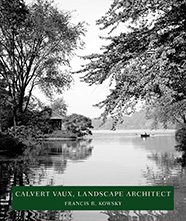 Good evening, friends, and thank you for coming to celebrate the publication by the Library of American Landscape History of a biography by professor of landscape-design history Frank Kowsky. More about this in a few minutes, but first take a look out of the large south-east facing window in this living room where you are sitting and find yourselves looking directly down at the American Museum of Natural History while at the same time sweeping your eye across the southern half of Central Park.
My husband Ted and I also relish our view from this vantage point of midtown Manhattan embracing the Park. It invariably brings us to ruminate on the fact that, when it comes to building a city as a five-borough cohesion of a multiplicity of residential, commercial, and institutional buildings, with a combination of engineering, architectural, and landscape planning forming a cityscape going from the skyscrapers known as “super-talls” to the green acres that include not just Central Park but also abound throughout New York City’s five boroughs. You can see what I have to say about this if you take a look at my book Green Metropolis, published by Knopf in 2016, which is a reprise of my first book, The Forests and Wetlands of New York City, published in 1969 by Little, Brown.
Just think for a moment about the four-centuries-long birthing, growth, and urban restoration of New York City and what this has entailed with regard to design and building practices that over time have become inter-dependently professionalized. To put this in brief: Architectural and landscape-design educations have fostered individual practices that necessitate original incentives wedded to collegial cooperation between client-and professional designer, a circumstance that falls into the category of friendship, thereby fostering appreciative mutual esteem.
Hello, Frederick Law Olmsted! In most people’s minds your name will forever be associated with Central Park. Indeed, your long arm merging accomplishment and influence stretches well beyond the park’s 843 acres.
All of us who are happily gathered in this high-floor apartment should now look down at the table where I have spread the books that sustain my remarks to you now. You may wish to take a first glance at the contents of the Library of America’s collection of Olmsted’s writings and then take a look at Frederick Law Olmsted: Designing the American Landscape by, which is dedicated to Frank Kowsky, our honoree this evening, whose admirable biography of a third builder of Central Park, Jacob Wrey Mould, is also on the table in front of us now.
Regarding the Bethesda Fountain and Terrace in the heart of the Park, I have several times seen a vintage photograph of Jacob Wrey Mould standing next to one of the two beautifully carved granite stairways leading down to Bethesda Terrace. I assume that this portrait picture was taken here because in addition to designing Angel of Bethesda Fountain, Mould was instrumental in the design and oversight of the carving of their beautiful stone side panels with compositions depicting the wildlife and plants of the four seasons of year.
My book titled Frederick Law Olmsted’s New York, which was published in 1972 as a text to accompany an exhibition at the Whitney Museum commemorating Olmsted’s one-hundred and fiftieth birthday anniversary that year, has a pair of illustrations that are portraits of both Olmsted and Vaux. If you could now align all three images of the original design team for the building of Central Park you would be paying homage to the three men who constitute a triumvirate in the artful building and management of an ever-after world-famous Park. Now, take note of the fact that all three of these men individually embarked upon important architectural and landscape-architectural projects following their years of concentrating upon the relation of Central Park’s design of carefully planned naturalistic artistry to the pleasures of its numerous visitors from both near and far.
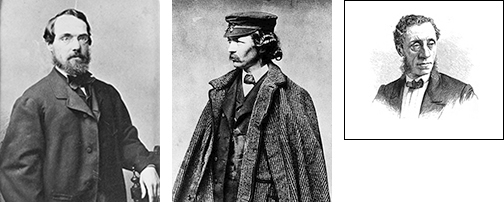
Left to right: Calvert Vaux, Frederick Law Olmsted, and Jacob Wrey Mould.
With this in mind, let us look out one of my apartment’s west-facing windows and get a distant glimpse of the Hudson River and its defining embankments. Now, I will say thank you for coming this evening, Sean Sawyer, president of the Olana Partnership and Mark Prokowski, Olana’s senior vice-president and landscape curator, both of whom, along with their expert colleagues, oversee the perpetuation of Olana as a New York State historic structure and landscape trust, a service that honors and supports the preservation of the dazzlingly great landmark within a slice of the Hudson River valley landscape that is the dual legacy of its original owner, the great nineteenth-century American landscape artist Frederick Church and the British-born architect Calvert Vaux.
Since we are now focused upon a famous nineteenth-century architect who became a co-designer of Central Park and deserves more than a mere mention here, I would like to turn your attention to the recently published, excellent biography titled Glorious Country: How the Artist Frederic Church Brought the World to America and America to the World by Victoria Johnson. Here you will find passages that refer to Vaux as the architect who collaborated with Church on the design of a spacious Hudson River Valley family home that offers both porch and balcony landscape-viewing platforms and large visitor-accessible rooms that continue to serve as a museum displaying paintings collected by Church on trips abroad, many of which are scenes of the Middle East, a principal tourist attraction for Church and his wife.
I am sorry that the landscape architect Thomas Woltz could not with us this evening and hope that Shawn Sawyer, president of the Olana Trust, will say a few words regarding his firm’s restoration plan for the Olama landscape as a grand Hudson River Valley home-turned-museum with its beautiful grounds as originally designed by Church while presumably accepting suggestions from Vaux and now gaining strength from Thomas’s typically ingenious principles in charting a long-term landmark stewardship plan.
I am pleased that Betsy Smith, the current president and CEO of the Central Park Conservancy could be with us now. Thank you, Betsy, for making possible the publication by Library of America of the writings of Frederick Law Olmsted. Moreover, I think that Olmsted would be pleased to meet you today as he looks over your shoulder at the 2025 Annual Report of the Central Park Conservancy, which outlines with praise the state of the park today.
Before we turn the floor over to Robin Karson, President and CEO of the Library of American Landscape History, who will introduce this evening’s speaker, Frank Kowsky, let me remark that, although credit for the design and building of Central Park is usually given to Frederick Law Olmsted, the entire project was accomplished by the triumvirate that included, in addition to Olmsted, Jacob Wrey Mould, and Calvert Vaux.
Share









